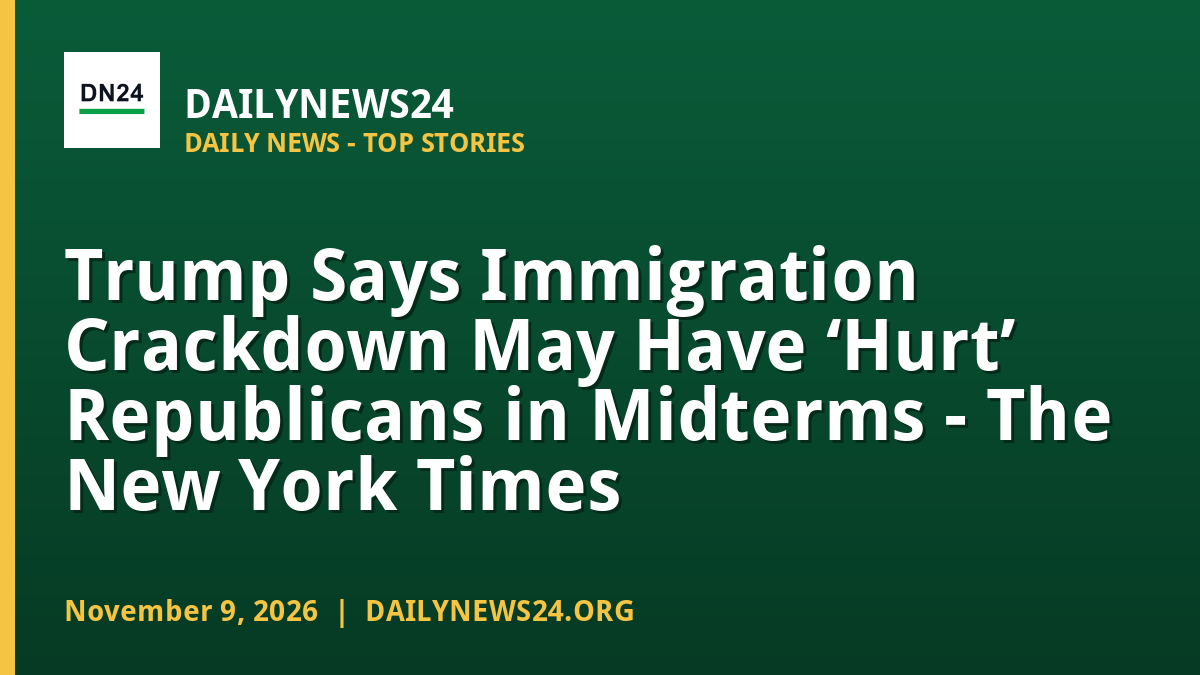
In a striking departure from his typical rhetorical style, President Donald Trump offered a candid admission regarding the impact of his administration's immigration policies on the Republican Party's electoral fortunes. Speaking in a recent interview with CBS's 60 Minutes, the President acknowledged that the intensified deportation campaigns may have inadvertently disadvantaged his party in the most recent midterm elections. This statement represents a significant moment of self-reflection, as it moves beyond standard political deflection to directly link specific policy actions to voter behavior and electoral outcomes.
The 60 Minutes Interview Breakdown
The interview, which generated widespread media attention, provided a detailed look at the internal calculations driving the White House response to the election results. While the President maintained that the core intent of the immigration crackdown was necessary and justified, he conceded that the execution might have been perceived as overly harsh by a segment of the electorate. This nuance is critical; it is not a retraction of the policy itself, but an assessment of its political cost. The President suggested that the volatility introduced by these measures created an environment where some potential Republican voters felt deterred or alienated, contributing to the party's losses in key congressional races.
Shifting the Narrative
Traditionally, the White House has attributed midterm setbacks to external factors such as economic conditions or Democratic campaign spending. However, this recent commentary shifts the narrative toward internal strategy. By acknowledging that the immigration stance was "too tough," Trump opens the door to a recalibration of approach. This is not merely a soundbite; it is a signal to the party establishment that the current aggressive posture may need adjustment if the GOP hopes to regain ground in future contests. The interview serves as a bridge between the campaign trail rhetoric and the governing realities faced by the administration.
Background on the Immigration Crackdown
To understand the weight of this admission, one must look at the scale of the actions taken. Since taking office, the administration has deployed federal resources to enforce immigration laws with a fervor not seen in decades. This included increased border security, rapid processing of asylum claims, and aggressive interior enforcement operations. These moves were central to the President's campaign promises and attracted a significant base of supporters who viewed them as long-overdue corrections. However, the sheer intensity of the enforcement drew sharp criticism from civil rights groups, legal experts, and some moderate conservatives who feared the alienation of Latino and suburban voters.
The Political Calculus
The midterm elections served as a litmus test for these policies. While the administration argued that the crackdown demonstrated strength and competence, the electoral map suggested a different story. In several swing districts, the turnout among traditionally Democratic-leaning demographics remained high, but there was a noticeable stagnation among swing voters who might have been sympathetic to the Republican message had it been less polarizing on this specific issue. The President's recent comments acknowledge this disconnect, suggesting that the political capital spent on immigration enforcement did not yield the expected return in seats held.
Competing Perspectives on the Policy Impact
The reaction to the President's comments has been divided along predictable lines. Supporters of the crackdown argue that the policy is morally imperative and that any electoral setbacks are temporary blips caused by a fierce Democratic opposition rather than the policy itself. They contend that the GOP should double down on enforcement, framing the issue as one of national security and rule of law. From this viewpoint, any moderation is seen as a capitulation to political pressure rather than a strategic necessity.
- Base Loyalty: Core supporters view the crackdown as a non-negotiable component of the President's agenda.
- Moderate Concerns: Swing voters may prioritize economic stability or healthcare over enforcement intensity.
- Democratic Strategy: Opponents are likely to use these comments to argue that the GOP is internally divided and inconsistent.
The Role of Media Framing
Media coverage of the deportation operations also played a role in shaping public perception. High-profile incidents, media coverage of family separations, or logistical failures at border facilities often dominated news cycles, providing fodder for critics. The President's admission suggests that the administration is aware of this media dynamic and recognizes that the visual and narrative impact of the crackdown may have outweighed the political benefits for their base. This highlights the increasing complexity of running a modern political campaign in the age of viral social media content.
Implications for Future Republican Strategy
What does this mean for the Republican Party moving forward? The President's comments signal a potential pivot in messaging rather than in policy action. While the administration is unlikely to halt enforcement operations, the tone and emphasis of their communications may shift. Instead of highlighting the sheer number of deportations, future campaigns may focus more on the economic benefits of secure borders or the rule of law, aiming to broaden the appeal of the platform. This strategic adjustment could be crucial in the lead-up to the next presidential election, where the stakes are significantly higher.
Internal Party Dynamics
Furthermore, this admission may influence internal debates within the Republican Party. Hardline advocates for immigration restriction may view this as a weakness, while pragmatic strategists may see it as a necessary correction. The tension between these factions will likely intensify as the party looks to unify its message for the next cycle. The President's willingness to acknowledge a potential mistake, even in a qualified manner, provides a path for the party to adapt without fully abandoning its core base.
What to Watch Next
In the coming months, attention will turn to how the administration implements this new understanding of voter sentiment. Analysts will be watching for changes in the rhetoric of GOP candidates, particularly in swing states where the midterms were closely contested. There may be an increased emphasis on other issues, such as energy policy or tax cuts, to provide voters with alternative narratives that are less polarizing. Additionally, the opposition will closely monitor any policy shifts to determine if this is a genuine strategic reversal or a tactical feint. The next few legislative sessions will be critical in determining whether the Republican Party can successfully translate this self-assessment into a more effective electoral strategy. For ordinary readers, the takeaway is that even the most assertive political movements are subject to the constraints of voter perception, and the ability to adapt is often the determining factor in long-term political success.