The Calculus of Conflict
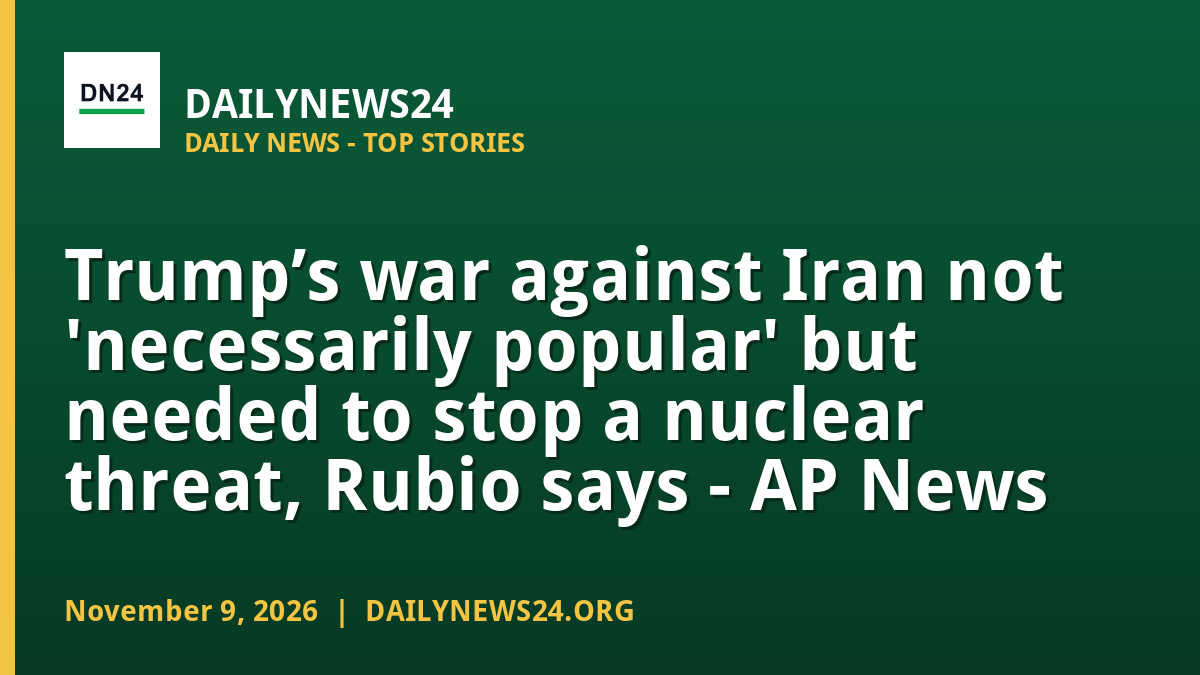
Secretary of State Marco Rubio has articulated a stark position on the potential for military conflict with Iran, stating that while such a war is not necessarily popular among the American public, it may be necessary to eliminate the regime's nuclear capabilities. This assessment marks a significant hardening of the administration's rhetorical stance, moving away from ambiguous diplomatic signaling toward a clear admission that the threat is real and immediate. The comments underscore a deepening divide within the political class over how to handle the Iranian nuclear file, with hawks arguing that deterrence is failing and that only decisive action can secure regional stability.
Rubio’s remarks come at a critical juncture, as reports from the Wall Street Journal and other major outlets indicate that Trump’s advisers are clashing over the next steps. The Secretary’s justification relies heavily on the premise that Tehran’s nuclear program has progressed too far for diplomatic containment to be a viable long-term strategy. By framing the issue as a binary choice between war and nuclear proliferation, Rubio seeks to preempt domestic criticism by appealing to national security imperatives over political popularity.
Fractures Within the Administration
According to reporting from the Wall Street Journal, the President is currently under pressure from competing factions within his own cabinet to make a definitive decision on Iran. On one side are advisors who advocate for aggressive military strikes to destroy Iran's enrichment facilities, arguing that time is running out. On the other side are those who caution that a full-scale war could destabilize the Middle East, spike oil prices, and draw the United States into another prolonged conflict. This internal friction has made policy formulation chaotic, with mixed signals leaking to the press and creating uncertainty among allies and adversaries alike.
The tension is not merely academic; it has operational implications for how the U.S. Department of State and the Department of Defense coordinate their responses. Rubio, as the chief diplomat, has found himself positioned at the center of this debate. His recent statements suggest that he has concluded that diplomacy is no longer a viable path to disarmament, a view that is shared by many national security hawks but contested by traditionalists who believe in the efficacy of negotiation under pressure.
The Diplomatic Dead End
Rubio has explicitly cast doubt on the possibility of a negotiated breakthrough with Tehran. He has described the Iranian demands as unrealistic, suggesting that the regime is using talks as a stalling tactic while continuing to enrich uranium. This perspective aligns with intelligence assessments that indicate Iran has already crossed key technical thresholds that would allow it to produce a nuclear weapon rapidly if it so chooses. The Secretary’s commentary reflects a growing consensus within the intelligence community that the window for preventing nuclearization through diplomacy alone is closing, or has perhaps already closed.
Public Opinion and Political Risk
The phrase "not necessarily popular" is a candid acknowledgment of the political risks inherent in launching a war against Iran. American public opinion has consistently shown low appetite for new military interventions in the Middle East, a sentiment that has shaped U.S. foreign policy since the drawdowns in Iraq and Afghanistan. However, Rubio’s argument posits that national security concerns must override electoral considerations. He is effectively asking the American public to prioritize the existential threat of a nuclear-armed Iran over the immediate economic and human costs of war.
This approach carries significant political risk for the President. If a conflict were to erupt and result in high casualties or an economic downturn, the initial justification of "necessity" could quickly be overshadowed by public backlash. Conversely, if the threat materializes and a nuclear weapon is tested, the failure to act would be remembered as a historic oversight. The administration is navigating a narrow path where inaction and action both carry severe political consequences, making the decision process highly sensitive and prone to internal debate.
The Nuclear Threat Explained
To understand the gravity of Rubio’s warnings, it is essential to grasp the technical situation in Iran. According to the International Atomic Energy Agency and U.S. intelligence estimates, Iranian centrifuges are enriching uranium to levels well beyond what is needed for civilian power generation. While the exact percentage of enrichment is a state secret, the capability to pivot to weapons-grade material is widely believed to be imminent. This "breakout time" is the metric that drives the urgency in Washington. The shorter the breakout time, the less leverage the U.S. has in negotiations, as the threat becomes more credible.
- Enrichment Levels: Iran’s stockpile of highly enriched uranium has grown significantly, providing the raw material for a potential weapon.
- Infrastructure: The number of advanced centrifuges has increased, accelerating the pace of enrichment.
- Breakout Time: Estimates suggest Iran could produce enough fissile material for a bomb in a matter of weeks to months, down from years previously.
These factors combine to create a ticking clock scenario. Rubio’s assertion that war is "needed" is rooted in the belief that diplomatic mechanisms, such as the Joint Comprehensive Plan of Action (JCPOA) or its successors, have failed to halt this momentum. The administration is increasingly viewing the nuclear program not as a negotiable trade chip, but as an immediate existential threat that requires a military solution.
Regional Ramifications and Global Impact
A conflict with Iran would have profound implications beyond the immediate strategic goal of destroying nuclear facilities. The Middle East is a region with complex alliances and proxy networks. Iran supports various armed groups, including Hezbollah in Lebanon, the Houthis in Yemen, and militias in Iraq and Syria. Any U.S. strike on Iranian soil would likely trigger reprisals against U.S. military bases, allies, and commercial shipping in the Strait of Hormuz, a critical chokepoint for global oil supplies.
For ordinary readers, the most tangible impact would be on the economy. A disruption in oil flows would likely cause a spike in gasoline prices, affecting transportation, logistics, and inflation. The global markets have already shown sensitivity to headlines regarding Iran, with oil prices fluctuating sharply in response to perceived escalations. Rubio’s role in shaping this narrative is crucial, as his statements can either calm or inflame these markets. By emphasizing the necessity of stopping the nuclear threat, he is attempting to frame the economic risks of war as preferable to the long-term security and economic costs of a nuclear-armed Iran.
What To Watch Next
As the administration deliberates, several key indicators will signal the direction of U.S. policy. First, the deployment of additional carrier strike groups to the region will serve as a clear message of intent. Second, any further reduction in IAEA oversight missions to Iran will be interpreted as a precursor to military action. Finally, the reaction from key allies, such as Israel and Saudi Arabia, will be critical. Israel has long warned of the danger of a nuclear Iran and has its own military plans, while Saudi Arabia is balancing its relationship with the U.S. against its own regional interests.
The coming months will determine whether Rubio’s assessment of necessity translates into action or remains a rhetorical tool for pressure. The administration must decide if the political capital required for a war is worth the strategic gain. For the American public, the message is clear: the debate is no longer about whether Iran poses a threat, but about whether the United States is willing to pay the price of war to stop it. The outcome of this deliberation will shape the security landscape of the Middle East for decades to come.