A Shift in North American Security Dynamics
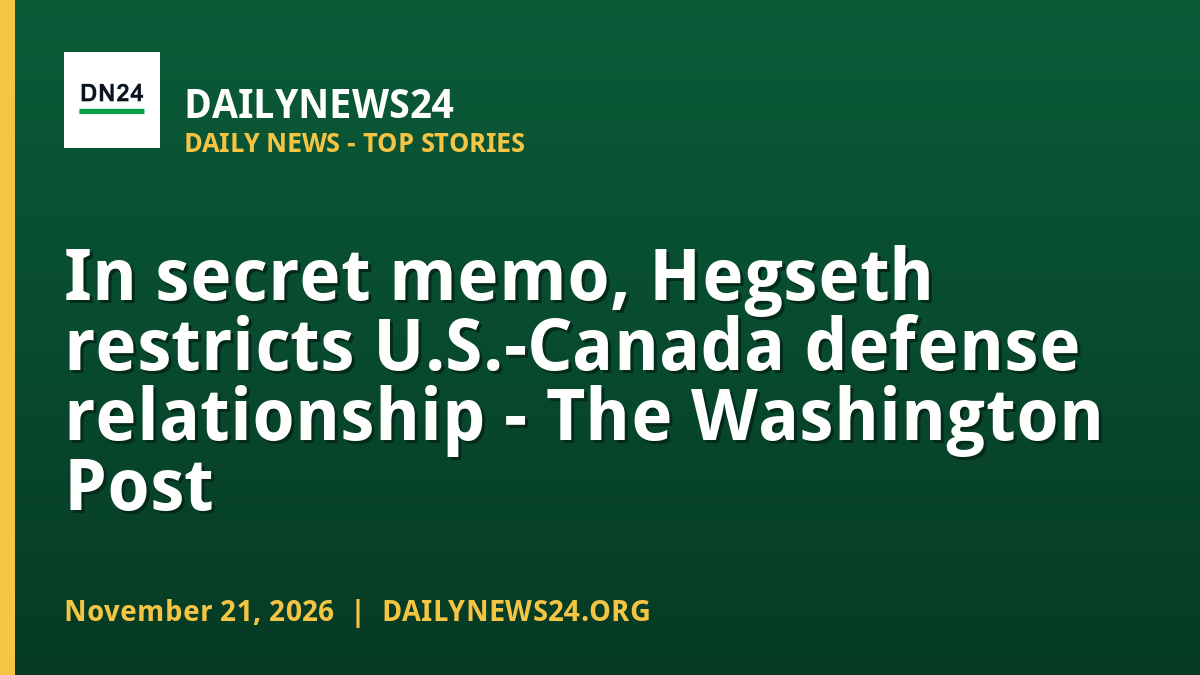
According to investigative reporting first published by The Washington Post and subsequently corroborated by Reuters, United States Secretary of Defense Pete Hegseth has issued a confidential internal directive that seeks to place new constraints on traditional bilateral military ties between the United States and Canada. The revelation of this classified guidance highlights an unexpected pivot in one of the most historically synchronized security partnerships in global history. For nearly a century, Washington and Ottawa have maintained deeply integrated command networks, routine joint operations, and a shared perimeter defense framework anchored by the North American Aerospace Defense Command.
While internal Pentagon policy directives frequently undergo review during administration changes, defense analysts note that establishing formal restrictions on engagements with an allied neighbor marks an uncommon development. According to details emerging from congressional circles and media accounts, the directive signals a reevaluation of foreign engagement protocols at the Pentagon. Observers emphasize that even marginal adjustments to bureaucratic procedures between the two militaries can create friction, potentially complicating diplomatic communication and practical synchronization along the world's longest undefended border.
Inside the Directives: Curbs on Social Engagements
Additional reporting by The New York Times highlighted that the directive includes specific measures designed to curtail informal gatherings and social activities between American service personnel and their Canadian counterparts. In traditional defense cooperation, social and ceremonial events serve as more than routine hospitality; military planners often rely on these informal networks to foster interpersonal trust, establish direct operational familiarity, and streamline real-time communication during continental emergencies. Restricting these interactions points to a more formal, distanced, and transactional operational posture from the leadership in the Department of Defense.
The policy document quickly drew the attention of lawmakers on Capitol Hill. As reported by The Independent, statements from members of the United States Senate have shed additional light on the scope of the Pentagon’s memorandum, raising concerns over congressional oversight and the overarching rationale behind cooling ties with a premier NATO partner. Lawmakers seeking clarity have questioned whether the shift reflects a broader policy doctrine or an administrative realignment targeting foreign military activities across the board. The debate underscores mounting unease within legislative committees tasked with national defense spending and foreign policy management.
Ottawa’s Reaction: Operational Realities vs. Policy Memos
Despite the attention surrounding the secret memorandum in Washington, officials in Ottawa have offered a measured response to the public revelations. Reporting by the Canadian Broadcasting Corporation indicated that Canadian government and defense leaders have observed no substantive disruptions to daily military cooperation on the ground. Routine operations, aerospace monitoring, and liaison officer postings have continued under their established routines, leading Canadian representatives to suggest that bilateral military engagements remain functional and intact despite the reported policy shifts south of the border.
This divergence between Washington’s internal documentation and Ottawa’s lived reality points to a complex implementation landscape within the Pentagon. Defense experts suggest that long-standing bilateral defense agreements, established over decades through formal treaties, cannot be easily dismantled through internal memoranda alone. Consequently, career military officials on both sides appear focused on sustaining practical interoperability, even as political appointees in Washington issue instructions aimed at redefining the character and proximity of future collaborative efforts.
The Historical Pillar of Joint Continental Defense
To fully understand the gravity of any restriction placed on U.S.-Canada military ties, one must consider the unparalleled depth of their integrated defense infrastructure. Since World War II, the two countries have coordinated their security umbrellas to protect shared airspace, naval approaches, and sovereign territory. The bilateral alliance is structured around multiple formal frameworks that are unique in international relations:
- The NORAD Agreement: Established in 1957, the North American Aerospace Defense Command features a bi-national command structure where a Canadian general can assume operational control of air defense forces over North America in the absence of the American commander.
- Bilateral Defense Production Sharing: Treaties designed to align the defense industrial bases of both nations, ensuring that military equipment, supply chains, and technical standards remain interchangeable.
- Arctic Security Initiatives: Joint surveillance and operational patrols across the northern polar approaches, a region increasingly contested by global competitors such as Russia and China.
- Five Eyes Intelligence Network: A comprehensive intelligence-sharing collective alongside the United Kingdom, Australia, and New Zealand that underpins Western strategic warning systems.
Given the level of structural integration detailed above, isolating one aspect of bilateral military interaction can generate ripple effects across broader mutual defense commitments. Operating joint defense facilities requires constant bureaucratic and interpersonal communication. When guidance from top political leadership discourages routine interface, the resulting institutional friction can create administrative backlogs and communication delays across critical security commands.
Strategic Repercussions for Continental Security
The strategic consequences of policy friction between Washington and Ottawa extend beyond diplomatic protocols and military social engagements. Both nations face complex international challenges, including heightened activity in the Arctic region, expanding ballistic missile threats, and persistent cyber operations targeting critical civilian infrastructure. Maintaining robust, uninterrupted interoperability has long been considered essential to closing operational vulnerabilities across the northern hemisphere.
For ordinary citizens in both countries, the stability of this military relationship has direct implications for everyday safety and national resilience. Continental defense agreements govern everything from domestic aerospace monitoring during civil emergencies to disaster response assistance and the protection of cross-border trade corridors. If institutional relations between the respective armed forces become strained, the capacity of both nations to mount swift, coordinated responses to non-military crises, such as cross-border environmental hazards or aviation security alerts, could be undermined by unnecessary bureaucratic hesitation.
Competing Perspectives on Defense Priorities
The reported actions by the defense secretary have brought competing philosophies of international engagement to the forefront. Proponents of reviewing foreign military ties argue that the United States must critically evaluate all bilateral arrangements to ensure American resources are prioritized effectively. From this perspective, reevaluating joint activities, formalizing boundaries, and demanding greater self-reliance from allied nations are necessary measures to protect national sovereignty and refocus defense expenditures on domestic readiness.
Conversely, foreign policy traditionalists and national security scholars argue that alienating historic partners poses severe risks to American strategic posture. Critics of the restrictions contend that continental defense is fundamentally indivisible: geography dictates that any threat approaching the North American landmass affects both countries simultaneously. These analysts maintain that eroding mutual confidence creates operational seams that foreign adversaries can exploit, weakening collective deterrence while yielding negligible administrative cost savings.
What to Watch Next
Moving forward, several key indicators will determine whether this memorandum marks an isolated policy statement or the beginning of a substantive rupture in bilateral relations. Observers should monitor upcoming congressional defense committee hearings, where lawmakers are likely to press Pentagon officials for direct testimony regarding the specific terms and operational impact of the memorandum.
Additionally, diplomatic tracking will focus on scheduled multinational exercises, NORAD modernization reviews, and high-level bilateral summits between defense officials in Washington and Ottawa. Should practical operational cancellations, staff reassignments, or broader policy shifts follow, it will signify a profound restructuring of North American security cooperation. Until then, observers on both sides of the border will be watching closely to see whether diplomatic pragmatism can bridge the growing divide between policy directives in Washington and operational obligations in the field.