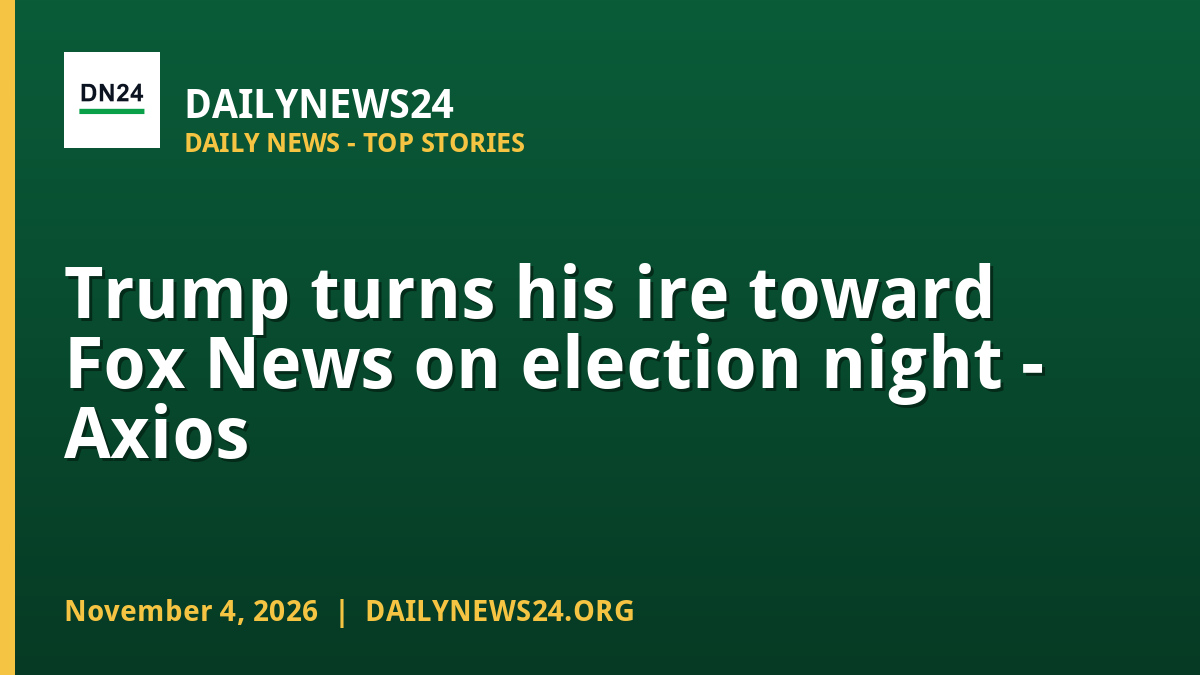
On a chaotic election night, the political landscape shifted in ways that few anticipated, leading to a public and pointed confrontation between President Donald Trump and Fox News. For years, the cable network served as a primary amplifier for the administration's messaging and a defensive shield against its critics. However, as results began to roll in and the narrative favored the opposing party, Trump did not shield his media partner. Instead, he directed significant ire toward the network, blaming its coverage for the perceived failure of his political objectives. This move represents a significant departure from the usual symbiotic relationship between the White House and conservative cable news.
The Breaking of the Unbreakable Bond
The relationship between Trump and Fox News had long been characterized by mutual reinforcement. When the president struggled in his public image, the network provided a platform to reshape the narrative. Conversely, when the network faced internal crises, the administration often stepped in to support its leadership. This dynamic was so entrenched that many observers considered the alliance unshakeable. Yet, the events of the recent election night shattered this perception. Trump’s public dissatisfaction was not subtle. It was a direct acknowledgment that the network’s performance did not align with his expectations or his political survival needs.
This shift was not merely a momentary outburst but a calculated signal. By publicly criticizing Fox News, Trump demonstrated a willingness to sacrifice a key media ally if that ally failed to deliver the desired outcome. It signaled to other media partners that loyalty is conditional and that reputation must be earned continuously through favorable coverage. For years, the network had enjoyed a degree of protection that shielded it from scrutiny, but that protection has now clearly expired in the eyes of the president.
The Role of Media in Modern Elections
Modern politics relies heavily on media ecosystems to define reality for the electorate. Cable news networks, particularly those with a partisan lean, often act as the primary lens through which voters interpret election night developments. When a network like Fox News fails to manage the narrative effectively, it can have tangible consequences for the politicians who depend on it. In this instance, the president felt that the network's coverage contributed to a perception of defeat rather than resilience. This highlights the high stakes involved in curated media environments, where the framing of events can determine the trajectory of political careers.
Internal Divisions Among MAGA Allies
The reaction from Trump’s core supporter base was immediate and fragmented. While Trump blamed the network, many of his loyalist media figures sought to deflect responsibility entirely. They argued that the election results were due to factors beyond anyone's control, such as voter behavior or structural advantages held by the opposition. This created a strange dynamic where the president and his allies found themselves at odds over who was to blame for the setback. The MAGA media ecosystem, usually tightly knit in its defense of Trump, showed visible cracks as different factions tried to assign fault.
Some loyalists argued that the network’s executives had veered too far into centrist territory, losing their edge in favoring the president. Others maintained that the network was doing its job but that the political environment had simply become too hostile. This internal debate reveals the fragility of the coalition that supports Trump. When success is shared, the credit is distributed broadly. When failure occurs, however, the blame game intensifies. The fact that Trump chose to target Fox News rather than his own strategy or the voters themselves suggests a desire to externalize the failure and maintain his personal brand of invulnerability.
The Political Cost of Public Criticism
Publicly criticizing a major media outlet carries significant political risks. It alienates a segment of the audience that consumes that media daily. For Trump, this meant potentially turning off conservative viewers who relied on Fox News for their news consumption. By attacking the network, he risked signaling that he was willing to abandon his base’s preferred information source. This is a calculated risk, but it is a dangerous one. It suggests that the president’s primary loyalty is to his own political survival rather than to the ideological community that built him. This distinction could have long-term implications for his relationship with the conservative movement.
Furthermore, this move weakens the broader conservative media landscape. If the most powerful figure in the movement can be openly critical of the leading conservative network, it sends a message that no ally is safe from attack. This creates an environment of instability where media partners are constantly on edge, trying to predict the next shift in the president’s mood or strategy. It also undermines the perception of a unified front against the political opposition. By turning inward, the administration gives the Democrats a gift, allowing them to point out the disarray within their ranks.
Impact on Future Media Relationships
The aftermath of this confrontation will likely reshape how other media outlets interact with the administration. Journalists and editors will be more cautious, aware that their coverage could be scrutinized not just by the public but by the White House itself. This leads to a chilling effect, where self-censorship becomes more prevalent. Outlets may avoid stories that could be interpreted as critical of the president, even if those stories are based on solid evidence. The goal is to avoid becoming the next target of presidential ire. This dynamic favors the administration, as it controls the narrative by threatening the very entities that are supposed to check its power.
On the other hand, some outlets may double down on their independence, using Trump’s criticism as a mark of their objectivity. They may argue that their accurate reporting is the only reason they are being targeted, thereby gaining credibility with skeptical viewers. The media landscape is likely to become even more polarized, with voices pushing further to the extremes to avoid the center ground that Fox News occupies. This polarization makes it harder for the public to find balanced information, further deepening the divide in American society.
What This Means for Democratic Politics
For the Democratic Party, this internal conflict among Republicans is a strategic advantage. It shows that the opposition is not a monolith. The Democrats can use this rift to question the reliability of the conservative media narrative. If the president can fire shots at his own allies, how much worse is the actual policy disagreement? This allows Democrats to frame the election not just as a policy debate but as a fight for media integrity and democratic norms. It shifts the conversation from specific policies to the health of the democratic process itself.
Moreover, the Democrats can leverage this moment to rally their base by highlighting the chaos in the camp of their opponents. By portraying the Republican side as divided and self-destructive, Democrats can energize their supporters and potentially attract moderates who are weary of the infighting. The key for the Democrats will be to remain consistent in their messaging, avoiding similar internal conflicts. They must present a united front that contrasts sharply with the visible disarray on the other side of the aisle.
Looking Ahead: The Road to Reconciliation
It is unlikely that this incident will permanently end the alliance between Trump and Fox News. The mutual benefits of the relationship are too great to abandon entirely. However, the nature of the relationship will likely change. It will become more transactional, with less implicit trust and more explicit demands for favorable coverage. The network may attempt to court the president with more aggressive programming, while the president may use the threat of withdrawal as a bargaining chip in future disputes.
For now, the political landscape is in a state of flux. The election night fiasco has exposed the vulnerabilities in the conservative media ecosystem. As the dust settles, both sides will reassess their strategies. The president will look for better media partners, and the network will try to regain his confidence. But the scar tissue from this public spat will remain, a reminder that even the strongest alliances in politics are fragile. The coming months will test whether this break is a temporary setback or the beginning of a permanent fracture in the conservative coalition.