The Market's Verdict on Political Risk
Wall Street has long grappled with the concept of "key man risk," but the recent volatility surrounding Elon Musk's business empire represents a new, more complex variant: political contagion. As the dust settles on the mid-term elections, investors are reacting not just to policy changes, but to the perceived erosion of the protective political capital that has underpinned Musk’s ventures for years. The simultaneous downturn in Tesla and SpaceX-related equities serves as a stark reminder that the financial health of major corporations can become inextricably linked to the electoral fortunes of their charismatic leaders.
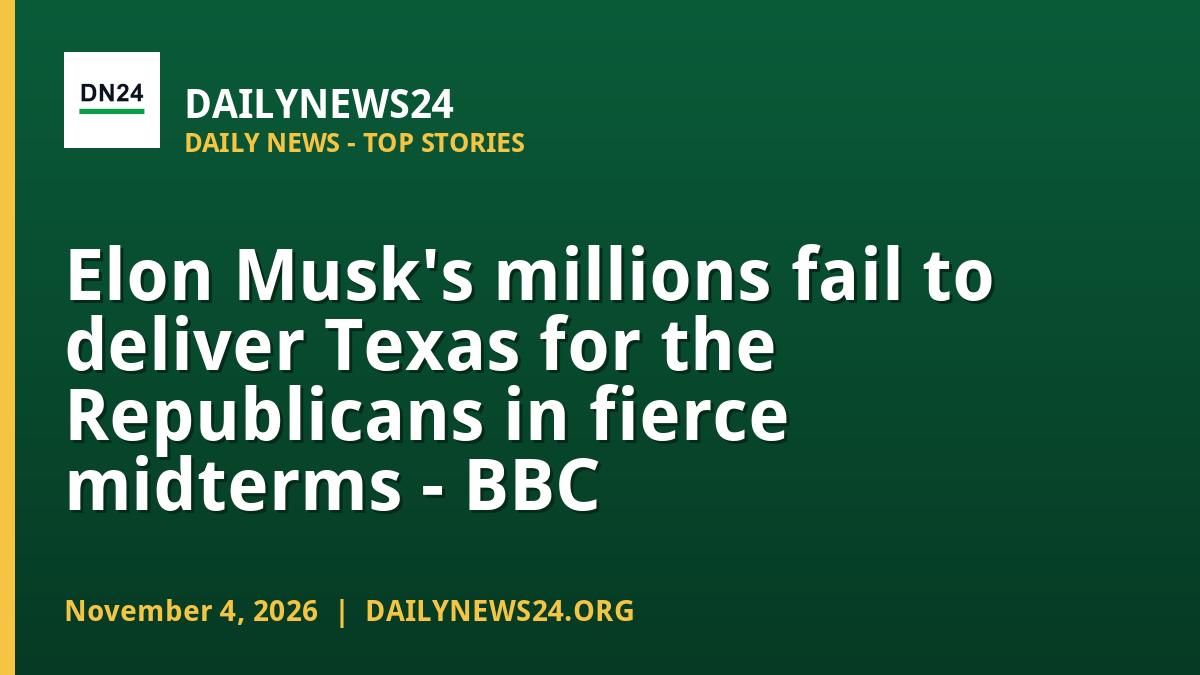
The primary catalyst for this sell-off was the stunning performance of the Democratic Party in Texas, a state that has historically been a stronghold for the Republican ticket. When candidates openly supported by Musk’s political action committees and financial backing lost ground in this critical battleground, the market interpreted the result as a signal that Musk’s political influence may be overstated or, more dangerously, that his alignment with the current administration could become a liability rather than an asset.
Texas: The Battleground That Shattered Expectations
Texas is not merely any swing state; it is the economic engine room of the American South and a critical market for both electric vehicles and aerospace infrastructure. The expectation entering the midterms was that Musk’s high-profile endorsement and financial support would help Republican candidates retain or expand their majorities, thereby securing a legislative environment favorable to his business interests.
- Electoral Reality Check: The Democratic wave in Texas resulted in significant losses for Republican incumbents, including those with Musk’s backing.
- Financial Impact: This electoral upset signaled to investors that the political safety net for Musk’s companies is thinner than previously assumed.
- Market Reaction: The immediate reaction was a sharp decline in investor confidence, leading to a reversal of recent gains in tech and automotive stocks tied to Musk’s brand.
The significance of these losses cannot be overstated. In a modern political landscape where social media influence and private wealth are increasingly viewed as valid forms of campaign finance, the failure of this high-stakes strategy suggests a ceiling to the efficacy of billionaire endorsements. For ordinary readers, this means that the stability of major industries relying on specific political outcomes is more fragile than corporate communications often suggest.
Quantifying the Stakes: A $60 Billion Question
Financial analysts have begun to quantify the cost of this political misstep. Reports indicate that the mid-term election cycle has already eroded over $60 billion in value from Musk’s personal fortune and associated enterprise valuations. This figure is not just an accounting entry; it represents a tangible shift in market sentiment. Investors who previously priced in a "Musk premium" for regulatory leniency and federal contract stability are now demanding a "political risk discount."
This discount manifests in several ways. First, the cost of capital for Tesla’s manufacturing expansions rises as lenders perceive higher operational risk. Second, the valuation of SpaceX, a private company, becomes more volatile as secondary market investors re-evaluate the security of its government contracts. If the political winds shift, the guaranteed flow of NASA and Department of Defense funding, which is vital for SpaceX’s liquidity, could face increased scrutiny or procedural delays.
The Entanglement of Brand and Politics
The core issue facing investors is the increasing entanglement of Elon Musk’s personal brand with his corporate entities. In the past, a CEO’s political views were considered a private matter, rarely affecting stock performance unless they resulted in regulatory action. Today, however, Musk’s online activities and political spending are viewed as direct inputs to corporate risk.
The Feedback Loop of Volatility
A concerning feedback loop has emerged. When Musk takes a political stand, media attention spikes, often dividing the public. If the political outcome is unfavorable, the subsequent media narrative focuses on corporate vulnerability, which depresses stock prices. This price depression can trigger algorithmic selling and forced liquidations, amplifying the initial market shock. The recent Texas results have tightened this loop, making the market hypersensitive to any news related to Musk’s political activities.
Competing Perspectives on Corporate Influence
Observers are divided on how to interpret this trend. One school of thought argues that the market is overreacting. Proponents of this view suggest that fundamental business performance, such as Tesla’s vehicle delivery numbers or SpaceX’s launch frequency, should remain the primary drivers of stock value. They contend that political noise is transient and that the long-term structural trends in the electric vehicle and space exploration sectors remain intact regardless of who holds office in Austin or Washington.
Conversely, a growing number of institutional investors believe the market is correctly adjusting its risk models. They argue that in an era of heightened regulatory scrutiny, having a CEO who is a polarizing political figure creates an unpredictable compliance environment. For these investors, the uncertainty regarding future government contracts, tax policies, and regulatory enforcement is a material risk that must be factored into valuation. They view the recent stock tumble not as a panic, but as a rational correction.
Implications for Ordinary Consumers and Investors
For the average reader, this story extends beyond the stock ticker. It highlights the growing intersection of corporate power and democratic processes. When a single individual’s political success or failure can swing the value of a major industry by billions, it raises questions about market stability and corporate governance.
Consumers buying electric vehicles or relying on satellite internet services may experience indirect effects. If corporate valuations drop due to political uncertainty, companies may cut costs, potentially slowing innovation or tightening service terms. Furthermore, the volatility seen in these stocks reflects a broader anxiety among investors about the reliability of political institutions in the corporate sector. This uncertainty can lead to more conservative investment strategies, potentially slowing the flow of capital into high-growth technology sectors.
Outlook: Navigating the Post-Midterm Landscape
Looking ahead, the market will likely remain volatile as it digests the new political reality in Texas and the broader implications for the federal government. Investors will be watching several key indicators in the coming months.
- Regulatory Announcements: Any new rules or investigations targeting Tesla or SpaceX will be scrutinized for political motivation.
- Contract Renewals: The timing and terms of new government contracts for space and energy infrastructure will test the limits of political goodwill.
- Executive言行: The tone and frequency of Elon Musk’s public political commentary will continue to be a major driver of stock sentiment.
Ultimately, the lesson from this episode is clear: the separation between business and politics, once assumed in corporate governance, is increasingly porous. For Musk’s empire to stabilize its value, the market will need to see a clearer distinction between his personal political ambitions and the operational resilience of his companies. Until then, the stocks will likely remain tethered to the unpredictable currents of American politics.