A Historic Vote and Its Immediate Aftermath
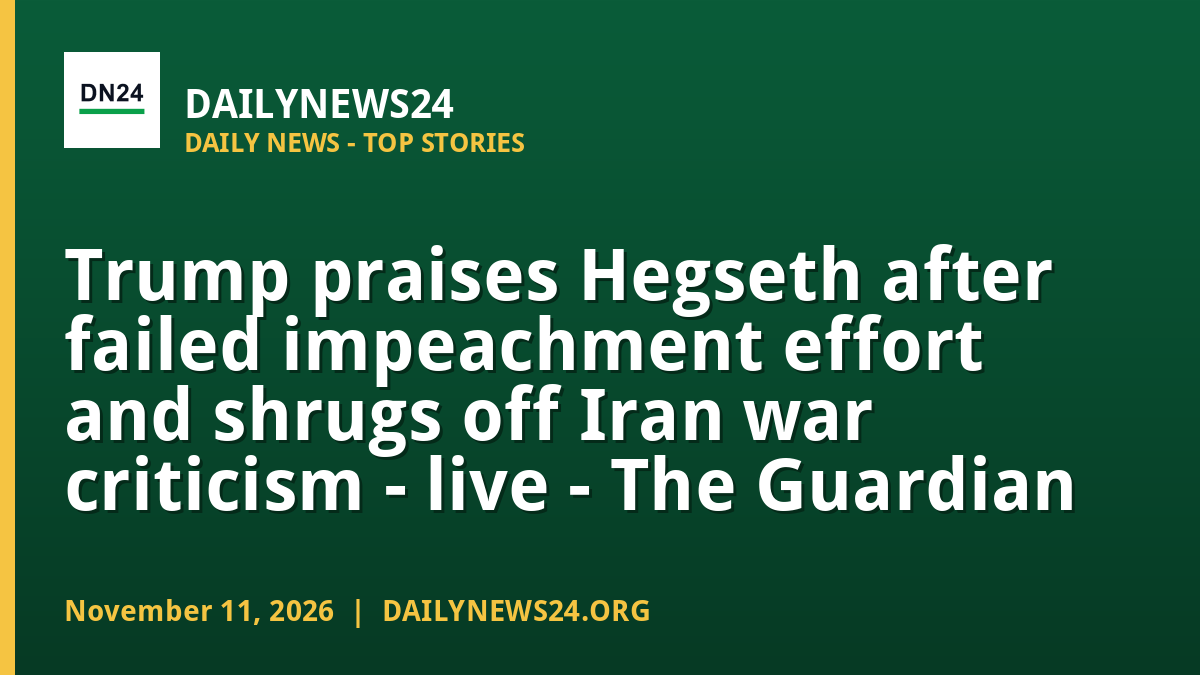
The United States House of Representatives recently concluded a significant procedural battle regarding the impeachment of Pete Hegseth, the Secretary of Defense. The effort to remove Hegseth from office failed to gain the necessary majority support, a result that has sent shockwaves through the political landscape. This outcome was not merely a procedural footnote; it represented a critical test of party discipline and the willingness of legislators to hold a sitting cabinet member accountable for alleged misconduct and policy disagreements.
The failure of the impeachment articles to pass the chamber highlights the deepening fractures within the Republican coalition. While the administration maintains that Hegseth is fully supported by the President, a growing faction of House Republicans has expressed unease over his conduct. The vote itself was closely watched by analysts who saw it as a referendum on the balance of power between the executive branch and the legislative oversight function.
The Mechanics of the Failed Effort
To understand the significance of this event, it is necessary to examine the procedural steps taken by the minority and dissenting majority members. Impeachment in the House requires a simple majority vote to adopt articles of impeachment. In this instance, the coalition pushing for Hegseth's removal struggled to secure the required numbers. Many Republicans, while critical of Hegseth's tone or specific decisions, stopped short of supporting formal impeachment, likely due to fear of primary challenges or loyalty to the President's agenda.
- The Democratic caucus unanimously supported the impeachment effort.
- A notable number of Republicans joined in voting for the articles.
- However, the majority of the Republican conference blocked the measure.
This dynamic underscores the difficulty of holding cabinet members accountable without broad partisan consensus. When a sitting President's allies hold key positions, the standard for impeachment often rises above simple misconduct, requiring evidence of high crimes or a fundamental breach of trust that spans party lines. The recent vote indicates that such a threshold was not met, at least in the eyes of the House majority.
Trump's Public Praise and Strategic Messaging
President Trump reacted to the failed impeachment with immediate and vocal support for Hegseth. In a series of public statements, the President praised the Secretary's loyalty and capability, framing the impeachment attempt as a partisan attack rather than a legitimate oversight action. This response is consistent with Trump's historical approach to political adversity, where he often rallies his base against perceived enemies by portraying criticism as an unfair persecution of his allies.
By shrugging off broader criticisms regarding the administration's foreign policy stance, particularly concerning Iran, Trump signaled a desire to unify his supporters around a common cause. The President's rhetoric served to dismiss the impeachment effort as a distraction from more pressing national security issues. This strategic messaging aims to consolidate the Republican base, ensuring that internal party conflicts do not translate into electoral weakness in upcoming midterms or future cycles.
The Iran Controversy and Foreign Policy Tensions
Parallel to the domestic political battle, the administration faces intense scrutiny over its handling of relations with Iran. Critics, including some members of Congress from both parties, have voiced concerns about the executive branch's approach to deterrence and potential conflict. The President has largely dismissed these warnings, arguing that strength and unpredictability serve as better deterrents than diplomatic engagement. This stance has drawn sharp criticism from international allies and domestic hawks who fear escalation.
The intersection of the Hegseth impeachment and the Iran debate is not accidental. Hegseth, as Defense Secretary, is at the forefront of military decisions and strategic planning. Therefore, questions about his competence and judgment are inextricably linked to concerns about how the United States will navigate complex geopolitical threats. The recent vote suggests that while there are doubts about Hegseth's suitability, the political cost of removing him currently outweighs the benefits for most Republicans.
Implications for Military Operations
Ordinary citizens are concerned about how these political squabbles affect real-world military operations. The uncertainty surrounding the Secretary's tenure can impact planning and execution of defense strategies. However, the Department of Defense operates with a degree of institutional stability that often shields it from immediate political turbulence. Career military officials continue to execute orders, and the chain of command remains intact despite the political noise in Washington.
Internal Party Dynamics and Future Risks
The aftermath of the vote reveals a House Republican conference that is more divided than ever. Senior leaders who supported the impeachment attempt are now facing pressure from the rank and file, who view the effort as disloyal. This internal tension could have lasting effects on party cohesion. If the administration continues to face controversies, the willingness of Republicans to support their own members in impeachment votes may fluctuate, creating an unpredictable environment for future oversight efforts.
- Short-term: The immediate risk is a loss of credibility for the opposition party, viewed as unable to hold power to account.
- Medium-term: Potential shifts in leadership alliances as members seek to protect their political futures.
- Long-term: A reevaluation of the constitutional role of the House in overseeing the executive branch.
For voters, this means that the mechanisms of accountability may be weakening. When the legislative branch fails to act against alleged misconduct, the burden of oversight shifts to the courts, the media, and ultimately, the ballot box. The recent events serve as a reminder that political loyalty can sometimes supersede institutional norms.
What to Watch Next
As the political dust settles, several key indicators will determine the trajectory of this story. First, any subsequent performance by Hegseth that draws fresh criticism could reinvigorate the impeachment threat. Second, developments in the Iran situation will test the administration's foreign policy decisions and potentially force a reckoning with their effectiveness. Finally, the primary election season will reveal whether the current party discipline holds or if primary challengers begin to target incumbents who voted against impeachment.
The coming months will be crucial in determining whether the Republican coalition can maintain its unity or if the fractures exposed by the Hegseth vote widen. For now, the President's praise for his Secretary and the dismissal of external criticism set the tone for a continued period of political confrontation. Readers should monitor official congressional records and official White House communications for any shifts in strategy or new allegations that could reignite this volatile issue.