The Erosion of Institutional Autonomy
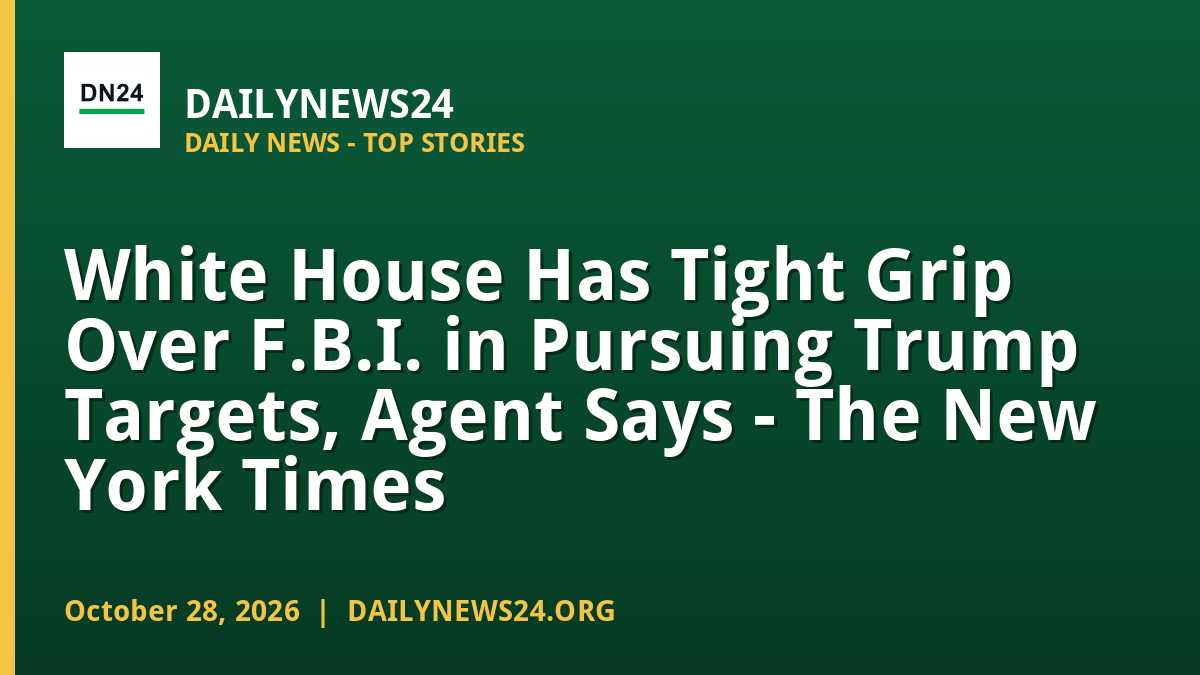
The separation between the executive branch's political leadership and the investigative apparatus of the Federal Bureau of Investigation has long been a cornerstone of American democratic safeguards. However, recent disclosures from within the agency suggest a significant shift in this dynamic. A senior FBI agent has indicated that the White House currently exercises a tight operational grip on investigations targeting individuals close to President Donald Trump. This revelation challenges the longstanding narrative that the FBI operates with complete independence from presidential influence, particularly when the sitting president is the subject of scrutiny.
This development is not merely a procedural technicality; it strikes at the heart of public trust in law enforcement. For decades, the FBI has relied on its reputation for neutrality to cooperate with state and local partners, as well as international allies. If that reputation is compromised by perceived political interference, the consequences ripple far beyond the walls of J. Edgar Hoover Building in Washington, D.C. The core issue now facing the nation is whether the bureau can remain a nonpartisan arbiter of justice or if it has become a tool of the executive branch.
Insider Perspectives on Operational Control
Defining the Scope of Influence
According to the agent’s account, the influence exercised by the White House is not limited to vague political pressure but extends to operational decision-making. In previous administrations, the relationship between the President and the FBI Director was one of oversight, with clear boundaries preventing direct interference in case files. However, the current environment appears to have blurred these lines. The agent suggests that decisions regarding the direction of investigations, the release of information, and the prioritization of cases are being made with significant input from the White House.
This level of involvement is unprecedented in recent history. While presidents have historically appointed FBI Directors, the expectation was that once appointed, the Director would shield the agency from political winds. The current situation implies a different reality, where the executive branch is actively steering the investigative process. This shift is particularly notable because the investigations in question involve the president himself and his inner circle, creating a direct conflict of interest that standard protocols are struggling to navigate.
The Context of Recent Investigations
The allegations arise against a backdrop of high-profile investigations into the handling of classified documents by former President Trump and other legal matters involving his associates. These cases have already become polarizing national issues, with supporters of the former president framing them as politically motivated prosecutions, while critics view them as necessary accountability for potential abuses of power. The suggestion that the current administration is influencing the FBI in these specific areas adds a complex layer to this debate.
It is crucial to understand that the FBI’s jurisdiction over these matters stems from federal statutes that do not change based on who occupies the Oval Office. Nevertheless, the execution of these laws can be perceived differently depending on who is in charge. If the bureau is seen as acting under the direct thumb of the White House, it undermines the legitimacy of any findings. Conversely, if the bureau stands firm against political pressure, it reinforces its institutional strength. The current tension highlights the fragility of this balance.
Competing Narratives and Political Implications
The Two Sides of the Coin
Political analysts and legal experts are divided on the implications of these reports. One perspective holds that any close coordination between the White House and the FBI is a normal part of governance, especially when national security or high-level legal strategy is involved. From this view, the White House has a legitimate interest in ensuring that the justice system functions in accordance with the administration’s policy goals.
- Proponents of executive oversight argue that the President must be able to hold the bureaucracy accountable.
- Critics counter that this argument is a pretext for undermining independent investigations.
- Legal scholars point out that the FBI’s role is to investigate facts, not to implement political agendas.
On the other hand, civil liberties groups and legal defense organizations argue that this level of involvement compromises the due process rights of the accused. They contend that when the entity accused of misconduct has significant influence over the investigating body, the fairness of the judicial process is inherently jeopardized. This perspective is gaining traction among those who view the current political climate as a test of the rule of law.
Impact on Public Trust and Institutional Integrity
Public opinion polls have consistently shown a decline in trust toward major political institutions, including the FBI. These recent reports are likely to exacerbate existing skepticism. For ordinary citizens, the idea that the FBI’s actions may be dictated by political convenience rather than legal merit is deeply concerning. Trust in the justice system is not a resource that can be easily replenished once it is eroded by perceptions of bias.
Furthermore, the international implications cannot be overlooked. Foreign governments and intelligence agencies monitor U.S. institutions closely. If the FBI is perceived as a partisan instrument, it may reduce the willingness of other nations to share sensitive intelligence or cooperate on joint investigations. The currency of the FBI is its credibility, and that currency is currently under heavy inflationary pressure.
Legal and Procedural Safeguards
The FBI operates under a set of internal protocols designed to prevent political interference. These include strict reporting lines that keep the FBI Director independent from direct presidential command on operational matters. Additionally, the Department of Justice has its own ethical guidelines that prohibit the use of law enforcement for political purposes. However, the effectiveness of these safeguards depends on the culture within the agency and the willingness of its leadership to enforce them.
In recent years, there have been instances where these safeguards were tested. The duration of investigations, the timing of indictments, and the handling of public statements have all been subjects of scrutiny. The current situation represents a stress test for these mechanisms. If the agent’s claims are substantiated, it would suggest that the internal culture of the FBI has shifted to accommodate, or even facilitate, executive influence. This would be a profound departure from the agency’s founding principles.
Outlook: What to Watch Next
As the nation moves forward, several key developments will determine the trajectory of this controversy. The first is the response from the White House and the FBI leadership. Will they deny the allegations outright, or will they attempt to contextualize the collaboration as standard practice? The second is the reaction from the judicial branch. Federal judges, who are appointed for life, may issue rulings that clarify the boundaries of executive influence on federal investigations.
Additionally, internal memos and communications from the FBI may become the subject of discovery in ongoing legal cases. If such documents reveal direct instructions from the White House regarding investigative tactics, the legal and political fallout could be severe. For now, the focus remains on maintaining the integrity of the process. The coming months will reveal whether the FBI can withstand the pressure to remain independent or if it succumbs to the gravitational pull of the executive branch. The stakes are high, not just for the individuals involved in these cases, but for the democratic norms that keep the system functioning.