The Strategic Pivot to Name-Brand Politics
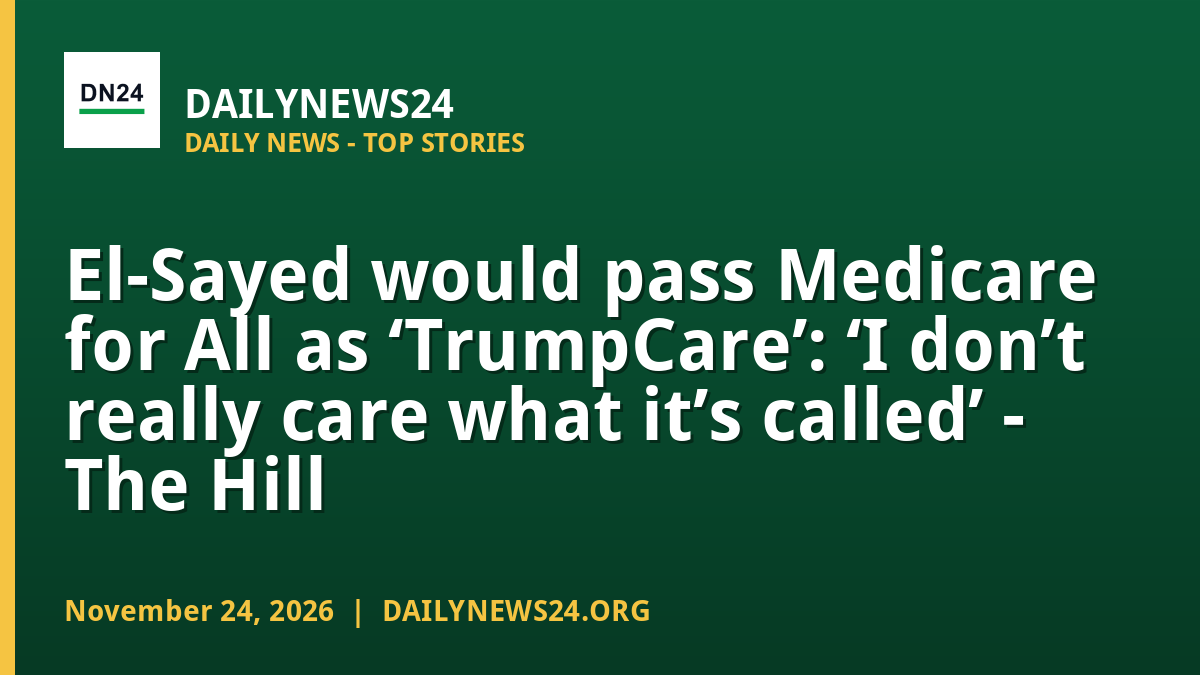
In a move that has sent ripples through the halls of Congress, former general practitioner Abdul El-Sayed has recently engaged in a calculated political maneuver regarding the nation's most contentious health policy. Rather than adhering strictly to the traditional progressive label of Medicare for All, El-Sayed has suggested that the underlying policy could be passed under the moniker of TrumpCare. This rhetorical shift is not merely semantic; it represents a significant attempt to decouple the economic substance of single-payer healthcare from its partisan branding. By offering the possibility of using President Trump’s name for the legislation, El-Sayed is testing the boundaries of bipartisan cooperation in healthcare reform.
The core of this proposal rests on a simple but provocative premise: the name attached to a bill should not dictate its viability. El-Sayed has indicated that he does not have a strong personal attachment to the specific terminology, provided the legislative mechanism delivers comprehensive coverage. This stance challenges the long-standing narrative that any form of government-sponsored universal healthcare is inherently anti-American or anti-free-market. Instead, it frames the issue as one of policy efficacy over political identity. For voters who are frustrated by the gridlock in Washington, this approach offers a novel pathway that bypasses the usual ideological traps.
Understanding the 'TrumpCare' Concept
To understand the implications of this proposal, it is necessary to examine what TrumpCare actually entails in the context of modern political discourse. Historically, the term has been used by conservative commentators to describe a system where the government acts as a single-payer insurer, competing with private entities. Critics argued that this would lead to rationing of care or the elimination of private options entirely. However, recent discussions have expanded the definition to include a mix of public and private components, potentially allowing existing insurance plans to coexist with a public option.
El-Sayed’s interest in this framework suggests a willingness to explore hybrid models that may have previously been dismissed by the broader progressive movement. This is a departure from the hardline platform of some 2024 Democratic candidates who have pledged to eliminate private insurance altogether. By remaining open to the possibility of keeping private insurance under a broader reform umbrella, El-Sayed positions himself as a pragmatist rather than an ideologue. This flexibility could be crucial in a Congress where both parties are hesitant to cross certain red lines regarding the role of the free market in healthcare.
The Role of Abdul El-Sayed in Modern Politics
Abdul El-Sayed’s entry into high-profile national politics was marked by his candidacy for the 2020 Democratic presidential nomination. As a practicing physician from Detroit, he brought a unique perspective that combined medical expertise with grassroots political experience. His campaign focused heavily on the intersection of race, class, and healthcare access, arguing that the current system disproportionately harms vulnerable communities. Although he did not secure the nomination, his presence helped to broaden the conversation around what kind of doctor the country needs in its political leadership.
Since then, El-Sayed has maintained a visible presence in political circles, often engaging in debates with both major-party figures. His recent comments on TrumpCare are part of a broader strategy to position himself as a bridge-builder. In an era where polarization has made legislative compromise nearly impossible on many fronts, El-Sayed is attempting to find common ground on an issue that affects every American. His background in medicine lends credibility to his policy statements, as he is not just discussing abstract economics but the tangible realities of patient care and hospital funding.
Competing Perspectives on Single-Payer Reform
The reaction to El-Sayed’s proposal has been divided along predictable lines. Supporters of the bill argue that the name is irrelevant compared to the potential to ensure that every citizen has access to quality healthcare without fear of financial ruin. They point to the successes of similar systems in other developed nations, noting that the U.S. currently spends significantly more on healthcare than any other country, yet lags behind in key health outcomes. For these advocates, the focus should be on the results, not the branding.
On the other hand, opponents, particularly from the Republican side, remain skeptical. They argue that any expansion of government involvement in healthcare will lead to increased taxes, longer wait times, and a reduction in the quality of care. They emphasize the importance of private competition in driving innovation and keeping costs down. Furthermore, some former Trump allies have expressed discomfort with the idea of associating the former president’s name with a policy that they might view as socially liberal. This internal division within the Republican Party complicates the prospect of a cross-party deal.
What This Means for Ordinary Americans
For the average voter, the debate over the name of healthcare reform may seem trivial, but the underlying policy has profound implications for daily life. If a version of TrumpCare were to pass, it could mean lower out-of-pocket costs for prescription drugs and hospital visits. It could also stabilize the insurance market for small businesses, which often struggle to keep premiums affordable for their employees. However, it could also result in higher income taxes to fund the expanded system, a trade-off that requires careful consideration.
Moreover, the political feasibility of such a bill is currently low. The U.S. healthcare system is deeply entrenched in existing insurance structures, and any major overhaul would require either a landslide victory for one party or an unprecedented bipartisan agreement. El-Sayed’s proposal serves as a thought experiment more than an immediate legislative plan. It highlights the tension between the desire for universal coverage and the fear of government overreach. Voters should be aware that the success of such a bill depends less on the name and more on the specific design of the program and the political will to implement it.
Looking Ahead: The Road to Legislative Clarity
As the political landscape shifts in the coming years, the debate over healthcare will only intensify. The aging population, rising drug costs, and ongoing public health challenges all point toward the need for systemic reform. Whether or not a bill explicitly named TrumpCare is introduced, the core ideas El-Sayed is promoting—namely, decoupling policy from partisan labels and exploring mixed public-private models—are likely to gain traction. Policy makers will need to engage with these concepts if they hope to make meaningful progress on healthcare affordability.
In the short term, watch for how other legislators respond to this framing. Will any Republican members of Congress engage with the idea of a single-payer option, however modest? Will progressive Democrats accept a hybrid model that preserves private insurance? The answer to these questions will determine whether El-Sayed’s rhetorical experiment leads to substantive policy change or remains a footnote in the complex history of American healthcare politics. The next few election cycles will be critical in testing the limits of bipartisan cooperation on this vital issue.