A New Era of Reciprocated Aggression
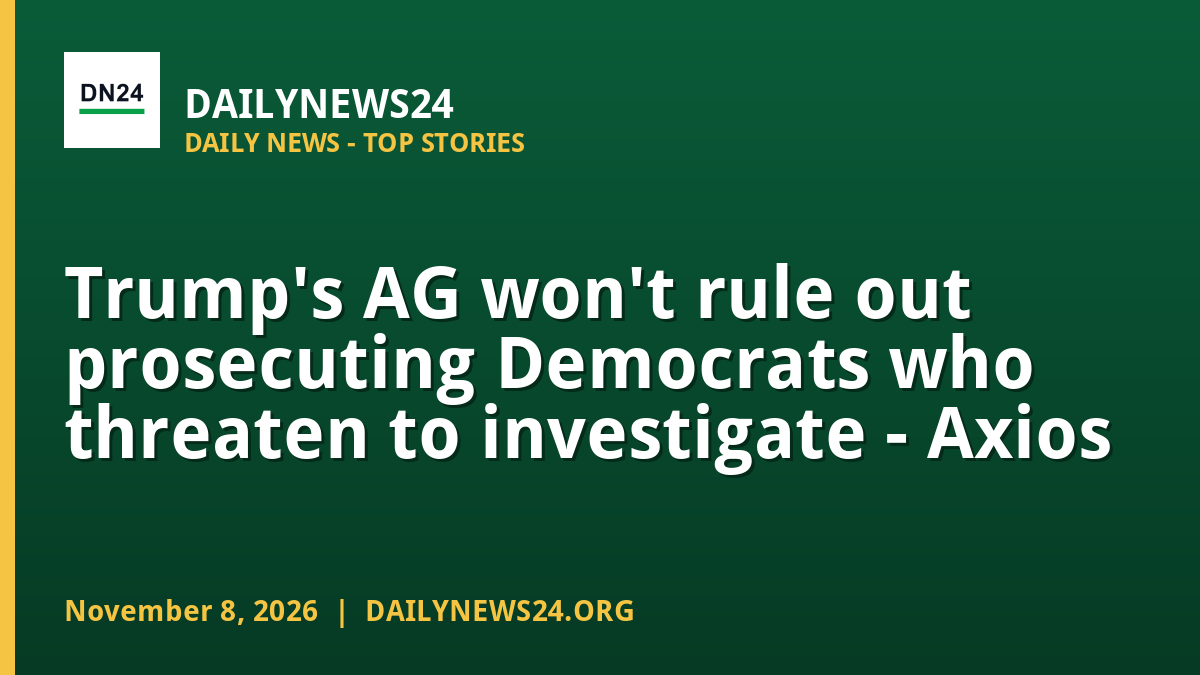
The landscape of American political oversight has shifted dramatically in the weeks following the recent elections. What was once considered a standard tool of congressional accountability is now facing unprecedented legal resistance from the executive branch. Attorney General Todd Blanche has made it clear that the Department of Justice (DOJ) will not stand idly by while legislative probes proceed. This stance marks a significant departure from historical norms, where the executive and legislative branches maintained a more distinct separation of aggressive investigative tactics.
Blanche’s position is not merely a passive defense of the administration; it is an active warning. By refusing to rule out the prosecution of lawmakers who he perceives as "threatening" individuals, the Justice Department is effectively signaling that it views congressional inquiries not just as political maneuvers, but as potential legal violations. This approach forces a reevaluation of the boundaries between political speech and criminal conduct in the context of government investigations.
The Backdrop of Recent Elections
To understand the intensity of this confrontation, one must look at the electoral changes that occurred recently. Democratic candidates have secured key seats in Congress, altering the balance of power in the legislative branch. This shift has emboldened members of the opposing party who are now positioned to scrutinize the actions of the current administration. For many of these lawmakers, launching investigations into the previous and current administration’s conduct is a primary objective.
However, the manner in which these investigations are being threatened has drawn sharp criticism from the Justice Department. Blanche and his team argue that certain rhetoric used by Democratic leaders goes beyond standard political debate and enters the realm of intimidation. This perception is central to the DOJ’s current strategy, which aims to deter such probes by highlighting the personal legal risks involved for the individuals leading them.
Blanche’s Explicit Legal Warning
Attorney General Blanche has been vocal in his refusal to dismiss the possibility of legal action against members of Congress. In recent statements, he indicated that the DOJ may probe lawmakers who engage in behavior that could be construed as threatening. This is a bold move, as federal prosecutors traditionally exercise extreme caution when considering actions against sitting legislators due to high thresholds of immunity and practicality.
The specific focus on "threatening" behavior suggests that the DOJ is looking for concrete evidence of intent to harm or intimidate, rather than just political disagreement. This distinction is crucial. It implies that the administration is seeking to draw a legal line between legitimate oversight and conduct that violates existing criminal statutes. By framing the issue this way, Blanche aims to legitimize the DOJ’s involvement in what was previously seen as a purely partisan dispute.
Democratic Counterarguments and Reaction
Democratic leaders have responded to these threats with indignation, characterizing the DOJ’s stance as an attempt to intimidate elected officials. They argue that the Constitution explicitly grants Congress the power to conduct investigations and that any attempt to punish lawmakers for doing their jobs is an overreach of executive power. This perspective holds that the separation of powers requires the executive branch to remain independent of legislative scrutiny.
Furthermore, many in the Democratic caucus view this as a preemptive strike designed to chill oversight before it even begins. They argue that by making threats of prosecution, the administration is trying to force lawmakers to abandon their constituent’s demands for transparency. This dynamic has created a charged atmosphere in Washington, where every statement is analyzed for legal implications rather than just political messaging.
Historical Precedents and Legal Ambiguity
The legality of prosecuting a sitting member of Congress for conducting an investigation is a complex and largely untested area of law. While members of Congress enjoy certain immunities regarding their legislative activities, these protections are not absolute. Historically, there have been very few instances where federal prosecutors have moved against lawmakers for acts related to their official duties, making this situation a potential legal landmark.
Legal scholars note that the definition of "threatening" in a political context is highly subjective. What one side views as a legitimate warning to resign or step down, the other may view as a criminal threat. This ambiguity provides both sides with rhetorical ammunition, but it also creates genuine uncertainty about where the legal boundaries lie. The outcome of this standoff could set a precedent that affects future interactions between the executive and legislative branches for decades.
The DOJ’s Strategic Calculus
Behind Blanche’s public statements lies a calculated strategy to manage the political fallout from the election results. The DOJ is likely aware that a full-scale prosecution of a sitting senator or representative would be politically explosive and legally fraught. Therefore, the threat itself may be the primary weapon. By keeping the option of prosecution on the table, the department aims to make the political cost of launching an investigation too high for most lawmakers to bear.
This approach allows the administration to maintain a posture of strength without necessarily committing to the logistical and political difficulties of an actual trial. It is a form of deterrence that relies on the uncertainty of the legal process. If lawmakers believe they are at risk, they may choose to modify their approach, focusing on less aggressive forms of oversight that are harder to characterize as threatening.
Implications for Ordinary Citizens
For the average American, this conflict has direct implications for government transparency and accountability. If the executive branch can successfully deter legislative investigations through the threat of prosecution, it may result in fewer public revelations about government misconduct or policy failures. This could lead to a less informed electorate and a greater concentration of unchecked power within the White House.
Additionally, the politicization of the Justice Department raises concerns about the rule of law. When legal actions are perceived as tools for partisan advantage rather than the enforcement of justice, public trust in institutions erodes. Citizens may become more skeptical of official narratives and more likely to seek information from alternative sources, further fragmenting the national consensus on basic facts.
Outlook: What to Watch Next
In the coming weeks, attention will turn to the specific actions of Democratic leadership. Will they proceed with announced investigations despite the threats, or will they shift their focus to less provocative areas? The response from the majority party in Congress will be a key indicator of the effectiveness of the DOJ’s deterrence strategy. A unified front from Democrats could galvanize their base and force the administration to back down, while a fragmented response may allow the executive branch to consolidate its control.
Legal observers will also monitor any formal filings or subpoenas issued by the DOJ or Congress. The first concrete move in this legal showdown will provide critical clues about the interpretation of the law. Whether this turns into a constitutional crisis or remains a contained political battle will depend on the restraint or aggression of both sides in the immediate future. The stakes are high, and the next few months will determine the new normal for American governance.