The Unmasking of a Global Financial Web
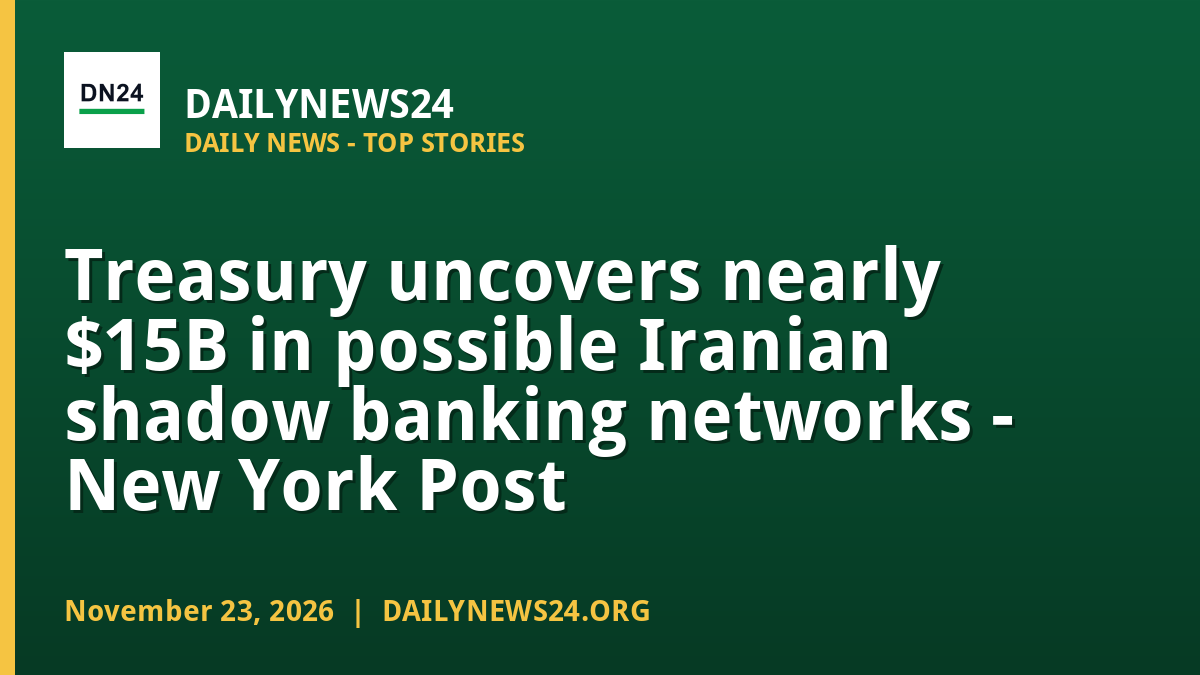
Washington officials have moved to dismantle what they describe as a sprawling, clandestine financial apparatus designed to circumvent decades of international isolation. The U.S. Department of the Treasury has identified a network of illicit transactions valued at nearly $15 billion, linking Iranian state entities with a web of intermediaries in the Middle East, Asia, and beyond. This revelation marks a significant escalation in the ongoing battle to starve Iran’s economy of the legitimate currency it needs to sustain its government and military programs. The actions represent a stark warning to financial institutions that the era of obscure, third-country transfers is coming to an end.
Defining the Shadow Banking Ecosystem
To understand the severity of this enforcement action, one must first understand the mechanics of the so-called "shadow banking" system. Unlike traditional money laundering, which often involves moving dirty money through clear, albeit illicit, channels, shadow banking relies on the obfuscation of the ultimate beneficiary. In the Iranian context, this network typically consists of front companies, shell entities, and intermediary banks in countries with weaker regulatory oversight. These actors facilitate the purchase of essential goods, such as medicine, food, and industrial equipment, while simultaneously allowing the Iranian state to evade asset freezes.
The Role of Intermediaries
The Treasury’s findings suggest that this $15 billion flow was not a series of isolated incidents but a systemic operation. Intermediaries in countries such as the United Arab Emirates, Turkey, and parts of Southeast Asia played pivotal roles in routing funds. By breaking down large transfers into smaller, less noticeable transactions and layering them through multiple jurisdictions, the network created a trail so complex that it had previously evaded detection by compliance teams. The new sanctions target these specific nodes, aiming to sever the connections that allowed the Iranian government to access the global financial system.
Geographic Focus: The Asian Vulnerability
A notable aspect of this recent enforcement wave is its geographical focus on Southeast Asia. The Treasury has specifically warned financial institutions in Singapore and Malaysia, two jurisdictions that have historically served as critical hubs for global trade finance. Recent reports indicate that a significant portion of the Iranian oil exports and other sanctioned goods were facilitated through banking channels in these regions. This shift in attention suggests that U.S. regulators are increasingly leveraging diplomatic pressure in Asia to close loopholes that have been exploited for years.
For ordinary readers and business owners, this has direct implications. Singapore and Malaysia are major trading partners for the United States and the broader global economy. By targeting banks and firms in these locations, the U.S. is signaling that compliance with sanctions is a condition of maintaining access to the dollar-based financial system. This could lead to tighter due diligence requirements, potentially slowing down legitimate cross-border trade for companies operating in these regions.
The Strategic Rationale Behind the Escalation
The decision to publicize the $15 billion figure is not merely punitive; it is strategic. The administration views the Iranian economy as the primary lifeline supporting its government’s stability and its regional proxy networks. By cutting off this last financial lifeline, the goal is to create domestic economic pressure in Iran that could potentially destabilize the ruling regime or force concessions in negotiations. The scale of the money involved—nearly $15 billion—highlights the sheer scale of the evasion efforts that had been underway. It serves as a testament to the ingenuity of the actors involved, but also to the reach of U.S. extraterritorial enforcement powers.
Impact on Global Sanctions Regime
This action reinforces the primacy of U.S. sanctions law in the global financial arena. Even banks outside the U.S. that wish to clear dollars or access U.S. correspondent banking relationships must adhere to these rules. The recent measures demonstrate that regulators are willing to look beyond the immediate transaction to identify the underlying purpose. This "risk-based" approach means that financial institutions cannot simply rely on surface-level checks; they must conduct deep-dive investigations into their counterparties.
Competing Perspectives and Criticisms
While the U.S. frames these actions as necessary for national security and regional stability, critics offer a different view. Some economists argue that such draconian measures exacerbate the humanitarian crisis in Iran, making it difficult for ordinary citizens to access basic necessities like healthcare and food. They contend that while the aim is to pressure the regime, the impact is often felt most acutely by the general population, who suffer from inflation and shortages. Furthermore, there are concerns that forcing Iran to rely on a shadow economy encourages further corruption and criminal behavior, rather than fostering transparency.
On the other hand, proponents of the sanctions argue that without total economic pressure, there is no leverage to compel Iran to adhere to international norms regarding nuclear proliferation and regional aggression. They point to the success of previous enforcement actions in curbing specific sectors of the Iranian economy. The debate highlights the complex trade-off between national security objectives and humanitarian concerns, a tension that remains unresolved in U.S. foreign policy circles.
Implications for Ordinary Readers and Businesses
For the average American, the immediate impact may be limited to higher energy prices if global oil supplies are disrupted by increased tension. However, the implications are broader for anyone involved in international trade. The tightening of compliance standards means that logistics companies, importers, and exporters must stay vigilant. A single link to a sanctioned entity, even indirectly, can result in severe penalties, including loss of banking access. This creates a "chilling effect" where businesses may avoid certain markets or customers entirely to mitigate risk.
Moreover, the focus on shadow banking networks suggests that financial transparency is becoming a non-negotiable standard. Consumers and businesses should expect to see more rigorous identity verification and transaction monitoring procedures from their financial institutions. This is part of a broader global trend toward anti-money laundering compliance, driven by the need to protect the integrity of the global financial system against illicit actors.
Outlook: What to Watch Next
In the coming months, the focus will likely shift to the enforcement actions in Southeast Asia. The response of Singaporean and Malaysian regulators will be a key indicator of how effectively the U.S. can enforce its sanctions abroad. Watch for secondary sanctions on specific banks or firms in these regions, which could lead to diplomatic friction. Additionally, monitor the reaction from Iran, which may accelerate its efforts to move its economy to a barter-based system or rely on cryptocurrencies to bypass traditional banking channels entirely. The battle between evasion and enforcement is ongoing, and this $15 billion discovery is just the latest chapter in a high-stakes financial war.