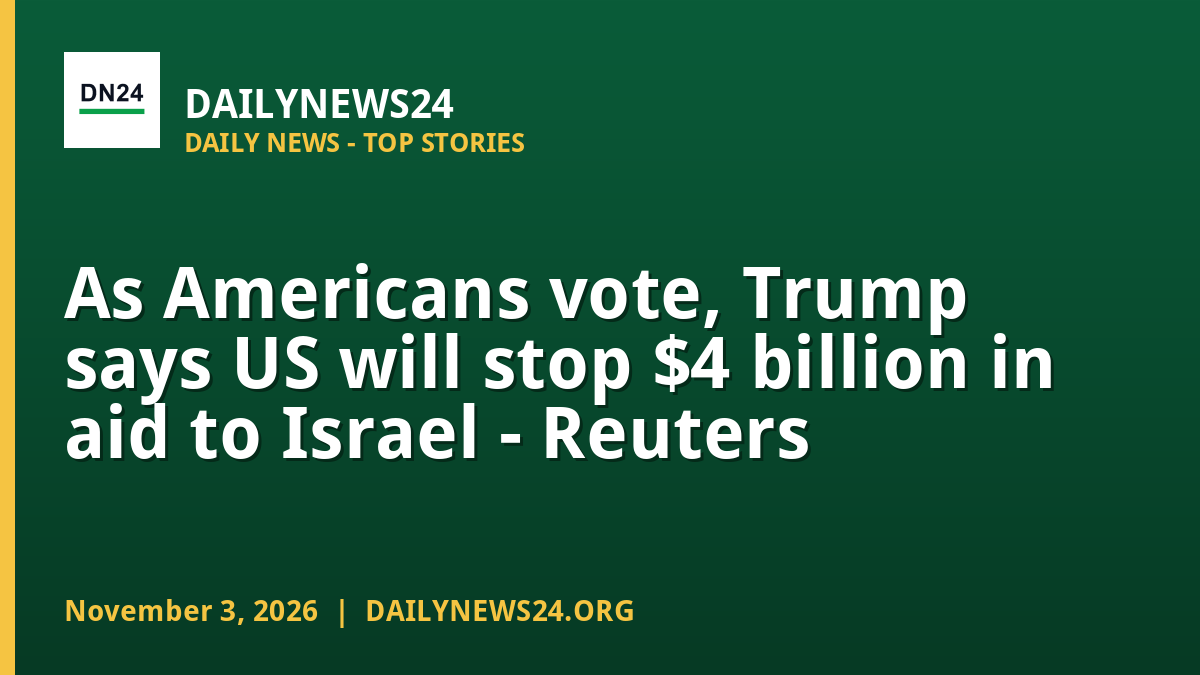
On a day when American citizens were focused on local and national elections, the White House delivered a geopolitical bombshell that dwarfed the ballot box news. The administration indicated that United States military assistance to Israel, a cornerstone of bilateral relations for decades, faces immediate termination. This announcement signals a potential rupture in one of the most significant alliances in the Middle East, with the specific figure of $4 billion in aid slated for cessation by the end of the year. The timing, coinciding with a period of heightened regional tension and domestic political maneuvering, has sent shockwaves through diplomatic circles worldwide.
The Scale of the Financial Cut
To grasp the magnitude of this decision, one must look at the financial mechanics of the agreement. The $4 billion figure represents a substantial portion of the annual military appropriation package that has sustained the Israeli defense apparatus for years. This funding is not a minor line item; it is the lifeline that allows for the procurement of advanced jet fighters, missile defense systems like the Iron Dome, and other critical hardware. By threatening to halt this flow, the administration is effectively withdrawing the economic backbone of the security partnership. Analysts note that this is not a negligible adjustment but a structural change that forces both nations to reconsider the long-term viability of their security architecture without predictable American support.
Implications for Defense Procurement
The immediate consequence of stopping this aid is a logistical and financial crisis for the recipient. Military budgets are often planned years in advance, relying on the certainty of allied support. A sudden stop of $4 billion creates a massive gap that must be filled domestically or through other international partners. This creates pressure on Israel’s own treasury and defense industry to scale up production rapidly. It also signals to other potential allies in the region that the United States may not be as reliable a guarantor of security as it has historically been, potentially altering the balance of power in ways that benefit opposing forces.
A Historic Shift in Diplomatic Norms
For decades, US aid to Israel was considered bipartisan and non-negotiable, a cornerstone of foreign policy that survived changes in administration and domestic political winds. This recent development marks a historic departure from that norm. The decision to link aid to political leverage rather than strategic necessity suggests a new era where financial assistance is treated as a transactional tool rather than a mutual commitment. This shift reflects a broader trend in American foreign policy where unilateral action and domestic political priorities are beginning to override established international alliances. It forces a re-evaluation of how other allied nations view their relationships with Washington, knowing that even their most steadfast support can be subjected to sudden political review.
Reactions from International Partners
The international community has reacted with a mixture of concern and cautious observation. European allies, who share many of the same security interests in the peace and stability of the Middle East, have expressed worry over the precedent set by this move. The potential for instability in the region is a shared fear, and the removal of a key stabilizing factor raises the stakes for all parties involved. Diplomats from various nations are now scrambling to understand the exact parameters of this cutoff and whether there are conditions under which the aid might be reinstated. This uncertainty complicates diplomatic efforts to maintain regional stability and opens the door for rival powers to step in and offer alternative support structures.
Domestic Political Dynamics
Inside the United States, the announcement has ignited a fierce debate over the direction of foreign policy. Supporters of the move argue that the US should stop funding allies who do not fully align with American strategic interests or who engage in actions that escalate regional conflicts. They view the aid as a drain on domestic resources that could be better spent at home. Critics, however, warn that abandoning this pillar of security undermines American influence and credibility. They argue that reliability is a core asset of US soft power, and that pulling back now sends a signal of decline to adversaries. The political calculus is complex, with different factions within the governing party arguing over the long-term implications of this aggressive stance. The move is seen by some as a domestic political play to demonstrate strength and independence, even at the cost of international relationships.
The Role of Congressional Oversight
While the executive branch has signaled this change, the ultimate authority on military aid rests with Congress. This creates a potential flashpoint for legislative conflict. Lawmakers who have traditionally supported the aid package may attempt to block or delay the implementation of the cutoff to preserve the strategic alliance. The process of unwinding such a large funding stream is not instantaneous; it involves complex legal and administrative procedures. This bureaucratic reality may slow the immediate impact of the announcement, but the political signal is already out. The coming months will see intense negotiations between the White House and Capitol Hill, where the fate of this aid will be determined by the balance of political power rather than just strategic necessity.
Strategic Consequences for the Region
The strategic landscape of the Middle East is likely to shift in response to this potential reduction in security guarantees. Israel may accelerate its own defense capabilities, seeking to become more self-reliant in areas where it previously depended on American supply. This could lead to a new arms dynamic in the region, as neighboring states observe the changing alliances and adjust their own procurement strategies. The risk of miscalculation increases when the predictable buffer of American support is removed. Regional actors who have relied on the status quo may feel emboldened to take more aggressive stances, knowing that the US safety net is thinner. This could lead to increased volatility, making the resolution of existing conflicts more difficult and potentially opening new fronts of tension.
Impact on Regional Stability
Stability in the Middle East has long been tied to American involvement, either through direct military presence or through arming local partners. By retrenching, the US is removing a key variable in the regional equation. This does not necessarily mean immediate conflict, but it does mean that the mechanisms for de-escalation become less reliable. Without the unifying factor of American aid and influence, the competing interests of various regional powers may clash more openly. The potential for proxy conflicts to escalate into direct confrontations rises, posing a threat to global energy markets and trade routes. The world is watching closely to see if this shift leads to a more multipolar and unstable environment in a critical region.
Outlook and Future Trajectory
Looking ahead, the next few months will be critical in determining whether this $4 billion cutoff becomes a permanent feature of US-Israel relations or a temporary political maneuver. The administration will likely face pressure to clarify its intentions, while Congress will move to assert its legislative prerogatives. Israel will engage in high-level diplomacy to lobby for a reversal or to seek alternative funding sources. For ordinary readers, the implications are not just abstract geopolitical shifts; they relate to the cost of living, the safety of global travel, and the overall stability of the world order. The era of unquestioned US support is ending, replaced by a more transactional and uncertain diplomatic reality. The coming weeks will reveal whether this signals a new normal or a temporary setback, but the damage to trust may already be done. The world must now adapt to a landscape where the most powerful ally is less predictable, and the consequences of that unpredictability are far-reaching.