A Strategic Delay
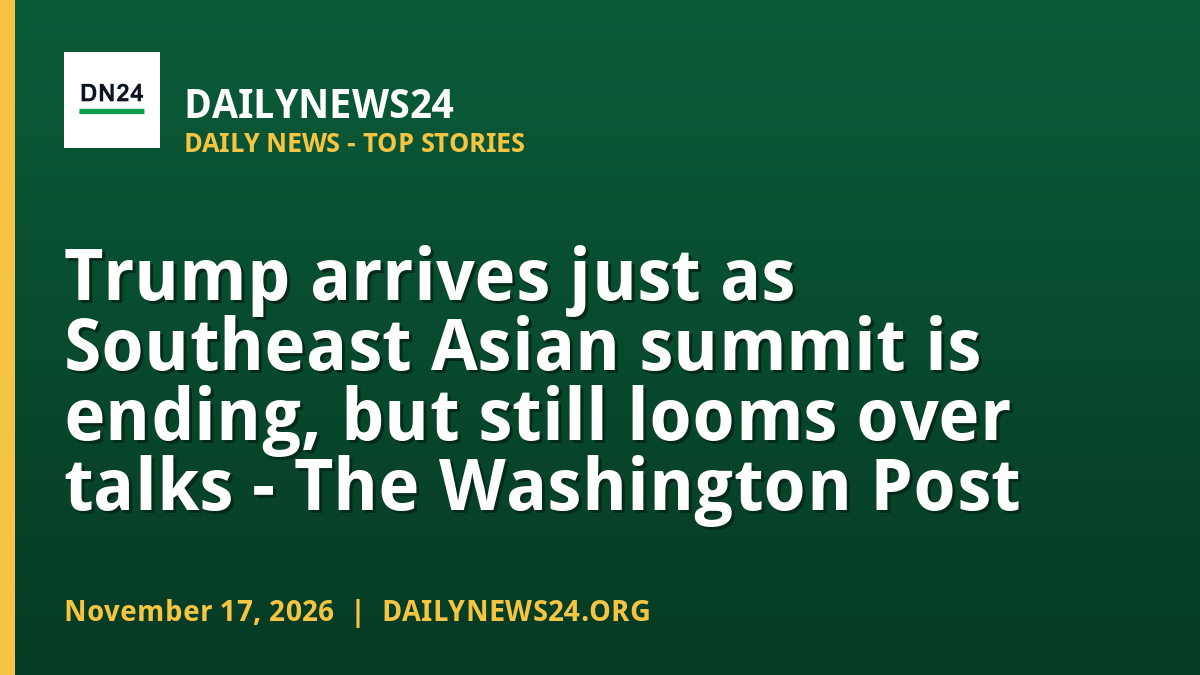
President Donald Trump’s arrival at the Association of Southeast Asian Nations (ASEAN) summit was notably late, marking a significant deviation from standard diplomatic protocol. By the time the American head of state stepped onto the stage, the primary multilateral sessions were already concluding. This timing did not simply represent a scheduling oversight; it signaled a shift in strategic priority. Instead of engaging deeply in the broad, consensus-building frameworks typical of ASEAN diplomacy, the focus immediately pivoted toward high-stakes bilateral engagements. The visual of a departing leader being joined by a new one underscored a moment of transition in Pacific security architectures.
The late arrival immediately redefined the energy of the summit. Delegates who had spent days negotiating regional trade and security norms found that the spotlight had moved away from collective action toward one-on-one negotiations. This shift highlights a recurring theme in recent American foreign policy: a preference for direct, bilateral leverage over multilateral consensus. For the Southeast Asian nations present, the absence of the US president during the core multilateral talks forced a recalibration of their expectations regarding American commitment to the region’s collective security goals.
The Philippine Priority
Upon his arrival, President Trump did not linger in plenary sessions but instead moved directly to a bilateral meeting with the President of the Philippines. This rapid pivot indicates that the alliance between Washington and Manila is viewed as the most urgent diplomatic task on the agenda. The Philippines has emerged as a critical partner for the United States in the South China Sea, where tensions with China have escalated significantly over recent years.
Defensive Alliances and Territorial Disputes
During their discussions, the two leaders emphasized the strengthening of their defense cooperation. Recent agreements have expanded the bases in the Philippines where US forces can be stationed, moving from five to more locations. This expansion is not merely symbolic; it provides the US military with greater logistical flexibility and a more robust posture in the western Pacific. For Manila, these alliances serve as a counterbalance to Beijing’s assertive maritime claims, offering a guarantee of security that is increasingly vital as regional flashpoints multiply.
The public praise of this defensive alliance by President Trump serves a dual purpose. Domestically, it projects strength and adherence to treaty obligations. Internationally, it signals to other ASEAN members that the United States remains a relevant security provider, even if its engagement style has shifted. However, this focus on the Philippine relationship also raises questions about how the US will balance its commitments to other members in the bloc, potentially creating hierarchies of partnership within the region.
The Shadow of China
While the US-Philippines talks dominated the immediate news cycle, the looming presence of China shaped every aspect of the summit. The context of these meetings is inseparable from the complex web of economic and geopolitical dependencies that link Southeast Asia to Beijing. China is the largest trading partner for most ASEAN nations, meaning that any security alliance with the United States is weighed carefully against the potential economic repercussions of antagonizing the world's second-largest economy.
President Trump’s subsequent movement toward talks with Russian and Chinese leaders further complicated the diplomatic landscape. The anticipation of high-level US-China dialogue casts a long shadow over the ASEAN summit. Delegates likely adjusted their rhetoric, avoiding statements that could undermine the prospects for de-escalation between the two superpowers. This dynamic illustrates the delicate tightrope that Southeast Asian nations walk, seeking to maintain open channels with both Washington and Beijing without being forced to choose sides in a widening strategic competition.
Economic Leverage and Security Dilemmas
The economic stakes of these geopolitical shifts are substantial. For ordinary citizens in the region, the outcome of these diplomatic maneuvers translates into trade stability, investment flows, and labor mobility. If tensions between the US and China rise, supply chains across the Pacific could face disruptions, affecting prices and job security. Conversely, a stabilized relationship could unlock new economic opportunities. The US focus on defense alliances, therefore, is not just a military calculation but an economic one, aimed at securing the stability required for free markets to function.
Multilateral Gaps and Regional Resilience
The absence of the US president during the core ASEAN phases highlights a potential gap in the architecture of regional multilateralism. ASEAN has long been defined by its consensus-based approach, where all members speak with a unified voice. When a major external power like the United States is absent from the main table, the ability to forge shared positions on critical issues like the South China Sea code of conduct is weakened. This forces the region to rely more heavily on informal channels and bilateral mechanisms to coordinate its response to external pressures.
However, this situation also demonstrates the increasing resilience and agency of Southeast Asian nations. No longer content to be passive spectators in the games of great powers, ASEAN members are actively diversifying their partnerships. They engage with the United States for security, China for trade, and other powers for development aid. This hedging strategy allows them to maximize benefits while minimizing risks, a pragmatic approach that has defined the region's foreign policy for decades.
Implications for Ordinary Readers
For readers outside the region, these diplomatic maneuvers might seem abstract, but their impacts are tangible. Global supply chains, energy prices, and even the availability of consumer electronics are influenced by the stability of the Pacific. If the US-China dynamic deteriorates, we may see increased volatility in global markets. Additionally, the strengthening of alliances in the Philippines suggests a potential increase in military activity in the region, which carries inherent risks of miscalculation or accidental conflict that could have far-reaching consequences.
Furthermore, the economic implications extend to labor and investment. US firms often look to Southeast Asia as an alternative manufacturing base to diversify away from China. The strength of the US-Philippines alliance could accelerate this shift, creating new economic hubs and job opportunities in the region. For US consumers, this may eventually lead to changes in product origins and potentially lower costs, though the transition period may bring initial disruptions.
Outlook and Future Watchpoints
As the summit concludes, attention turns to the upcoming high-level talks between the United States, China, and Russia. The outcomes of these trilateral or bilateral meetings will determine the broader tone of US foreign policy in the Asia-Pacific. Analysts are watching for signs of whether President Trump’s approach will prioritize direct negotiation with Beijing on trade and security, or if it will continue to rely on alliance structures to manage competition.
In the coming weeks, the specific details of the expanded US bases in the Philippines will likely become a focal point for both domestic and international policy debates. Critics may argue that such deployments increase the risk of conflict, while proponents will view them as necessary deterrents. For ASEAN nations, the next few months will be critical in determining how successfully they can navigate the competing interests of the US and China. The region’s ability to maintain its neutrality while securing its interests will be the defining test of its diplomatic maturity in this new era of great power competition.