An Unprecedented Diplomatic Gathering
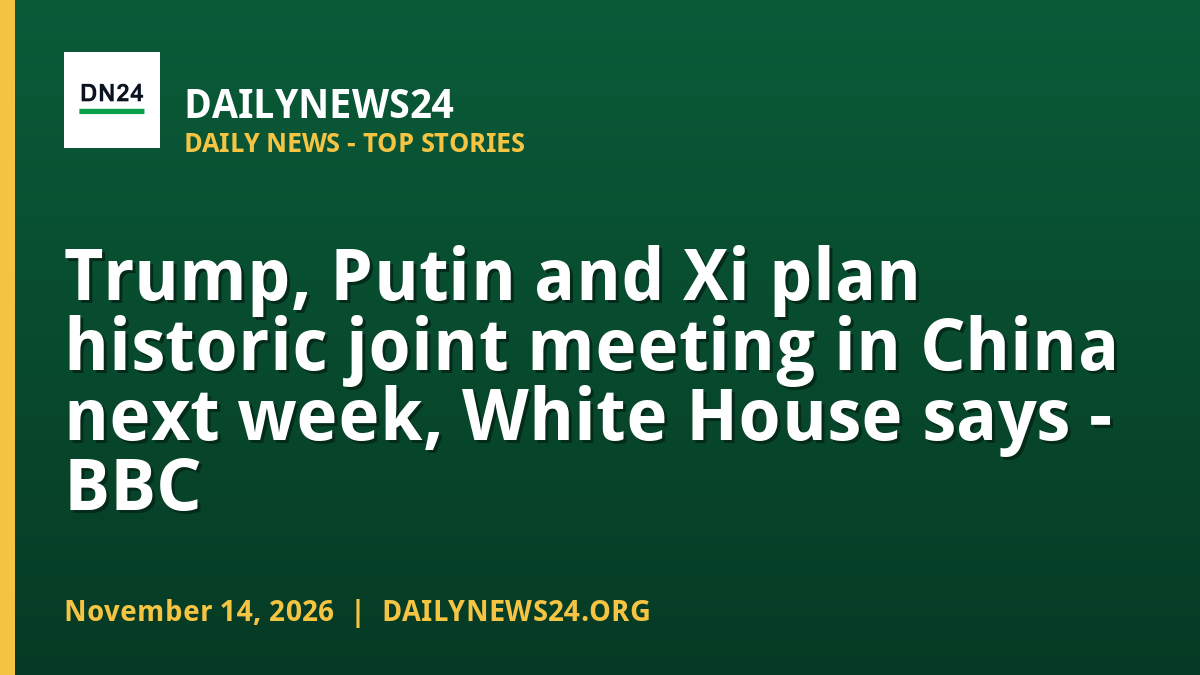
The geopolitical landscape is poised for a significant shift as the White House confirmed that President Donald Trump will join Russian President Vladimir Putin and Chinese President Xi Jinping for a historic trilateral meeting in China next week. This joint sit-down marks a rare instance where the heads of the world's three most powerful nuclear states convene face-to-face under one roof. While bilateral summits between these leaders are not uncommon, a simultaneous trilateral engagement is exceedingly unusual and carries substantial symbolic weight for international relations. The announcement has triggered immediate speculation about the potential outcomes, ranging from tangible arms control agreements to broader geopolitical realignments that could redefine the post-Cold War order.
According to official statements, the primary agenda for the gathering centers on nuclear non-proliferation. The leaders are expected to discuss mechanisms to prevent the spread of nuclear weapons and potentially address the existing stockpiles held by their respective nations. This focus comes at a time when global tensions are high, and the risk of nuclear miscommunication or escalation is a persistent concern for policymakers and security experts alike. The inclusion of all three major powers in this specific topic signals a shared, albeit likely reluctant, acknowledgment that nuclear stability requires multilateral cooperation rather than just bilateral maneuvering.
The Strategic Context of the Summit
Why China Is the Host
The decision to host the summit in China is a strategic choice that reflects Beijing’s growing confidence in its global diplomatic standing. By hosting both the American and Russian leaders, China positions itself not just as a participant in the global conversation, but as a central mediator and pillar of international stability. This move challenges the traditional Western-centric model of diplomatic gatherings, which have historically taken place in European or North American venues. For Beijing, demonstrating the ability to host such high-stakes diplomacy is a significant soft-power victory, underscoring its role as an indispensable actor in global affairs.
However, the location also introduces complex dynamics. Russia and China have deepened their strategic partnership in recent years, often coordinating on issues regarding NATO expansion and US foreign policy. Holding the meeting on Chinese soil may create an implicit sense of solidarity between the host and the guest from Moscow, potentially complicating US efforts to seek balanced concessions. Analysts note that the physical setting can influence diplomatic negotiations, and the neutral ground of a third party, in this case China, raises questions about whose interests are truly being advanced in the room.
Nuclear Arms Control: The Central Negotiation
The core of the discussions will likely revolve around the state of nuclear arms control treaties. The New Strategic Arms Reduction Treaty (New START), the last major bilateral cap on nuclear weapons between the US and Russia, has faced numerous threats of expiration and non-renewal. With the United States, Russia, and China all possessing vast nuclear arsenals, the absence of a comprehensive, trilateral limit on warheads and delivery systems has long been a point of contention. Trump’s administration has previously hinted at a desire to negotiate new arms control frameworks, and this summit presents the perfect stage to initiate such talks. The goal is not necessarily to disarm immediately, but to establish a new baseline for transparency and limitation that accounts for the modernization of nuclear forces in all three countries.
China has historically resisted being included in arms control talks at the same level as the US and Russia, arguing that its arsenal is far smaller and that it maintains a minimum deterrence posture. However, the rapid modernization of China’s nuclear capabilities, including the development of intercontinental ballistic missiles, has drawn attention from Washington and Moscow. For the summit to succeed, the US and Russia must find a way to engage China meaningfully without isolating it or forcing it into commitments that contradict its stated defense policies. This delicate balancing act will be the primary challenge for the negotiators in the coming days.
Competing Perspectives and Historical Echoes
Historical comparisons are inevitable when three major powers gather to discuss the balance of power. Critics, including some former diplomats and journalists, have drawn parallels to the Yalta Conference of 1945, where the Allied leaders carved up post-war Europe, often to the detriment of smaller nations. The term "Yalta" has become a byword for betrayal and the manipulation of sovereign states by great powers. This comparison serves as a warning to observers that the interests of ordinary citizens in Europe, the Middle East, and Asia may be secondary to the strategic calculations of the three leaders at the table. The fear is that any agreement reached in Beijing could result in a new geopolitical order that marginalizes democratic allies and prioritizes the strategic autonomy of the three autocratic or semi-autocratic systems.
On the other hand, proponents of the summit argue that the alternative to dialogue is dangerous. Without direct communication channels, the risk of accidental nuclear conflict increases. The establishment of a trilateral framework for crisis management could serve as a crucial safety valve in a volatile world. Supporters point out that while the leaders may not agree on every issue, the mere fact of their engagement signals a commitment to avoiding direct confrontation. For ordinary readers, the stakes are high: a successful summit could lead to a period of reduced tension and predictable international law, while a failure could embolden aggressive posturing and accelerate arms races that undermine global security.
Implications for Ordinary Citizens
While the discussions will take place in high-level rooms, the consequences will be felt far beyond the boardroom. Nuclear stability is the foundation of global economic security. A world where the risk of nuclear war is perceived to be higher leads to fluctuating markets, increased defense spending, and less investment in social programs. Conversely, a successful reduction in tensions could free up resources for other priorities. For citizens in the US, Russia, and China, the outcome will influence the level of anxiety surrounding global events and the perceived safety of their nations. Furthermore, the diplomatic norms set in Beijing will affect how other countries navigate their relationships with these three powers, potentially leading to new alliances or isolations that impact trade, travel, and cultural exchange.
The domestic political implications are also significant. In the United States, the President will likely frame the summit as a victory for American leadership and security, emphasizing the willingness to engage with adversaries to protect national interests. Critics may question the concessions made or the validity of the agreements reached. In Russia and China, the leaders will likely present the meeting as a testament to the strength and resilience of their systems against Western pressure. These varying narratives will shape public opinion and political discourse in all three countries for months to come, making the summit not just a foreign policy event, but a domestic political reality.
Outlook: What to Watch Next
As the summit approaches, attention will turn to the specific language of any joint declaration issued afterward. Vague statements of intent are common in such high-level diplomacy, but analysts will be looking for concrete commitments, such as the formation of a working group to draft a trilateral arms control treaty or the agreement to regularize communication channels between military leaders. The timing of the meeting, just a week away, suggests that preliminary negotiations have already taken place, and the leaders are likely to have a general sense of the terms they are willing to accept.
Observers should also watch for reactions from other global powers, particularly France and the United Kingdom, who are the only other nations with nuclear weapons. Their exclusion from the core trilateral talks highlights the hierarchy of nuclear states and may lead to their own diplomatic initiatives to ensure their security concerns are addressed. In the coming days, the world will be watching Beijing not just for the handshake photos, but for the subtle shifts in tone and policy that signal whether this historic meeting will result in a new era of stability or simply a brief pause in an ongoing geopolitical competition.