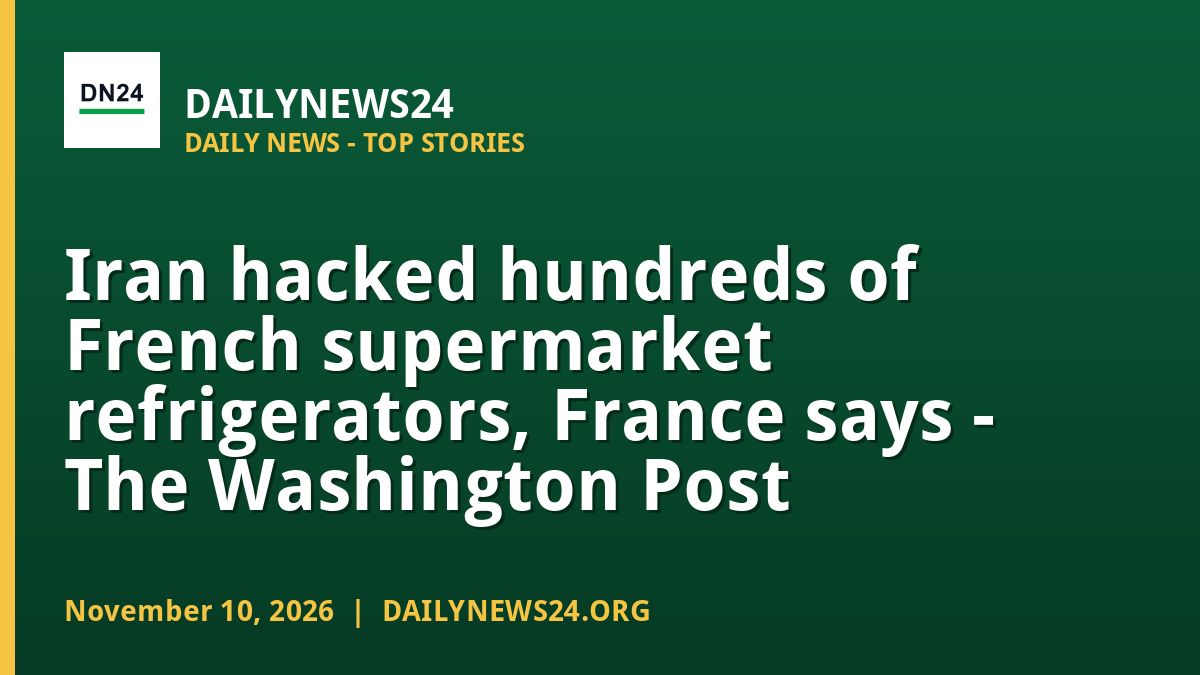
France has formally accused the Islamic Revolutionary Guard Corps (IRGC) of launching a coordinated cyberattack against the country’s retail infrastructure. According to official statements, Iranian hackers gained unauthorized access to the cooling systems of hundreds of major supermarket chains across the nation. This incident represents a notable shift in the landscape of state-sponsored cyber operations, moving away from purely data exfiltration toward the potential disruption of physical supply chains and public health safety. The revelation has intensified diplomatic tensions between Paris and Tehran, prompting calls for a robust and unified European response to the threat.
The Anatomy of the Cyber Intrusion
The technical details of the breach, as reported by French intelligence agencies, suggest a targeted approach rather than a wide-scale, indiscriminate hack. The attackers utilized specific vulnerabilities in the software controlling industrial refrigeration units used in large grocery stores. By manipulating the temperature settings remotely, the hackers could cause freezers to malfunction or shut down entirely. While no immediate physical harm has been reported, the potential for food spoilage and logistical disruption was significant. The scope of the attack, involving hundreds of locations, indicates a well-organized operation capable of affecting a substantial portion of the French retail sector simultaneously.
Technical Sophistication and Execution
Analysts have noted that the methods employed were relatively unsophisticated by modern cyberwarfare standards. The intrusion relied on known security flaws in legacy hardware systems, which are common in industrial environments but often overlooked by retailers focused on digital payment security. This simplicity, however, does not diminish the strategic impact. Even basic manipulation of critical infrastructure can have outsized consequences when applied at scale. The reliance on older technology highlights a persistent vulnerability in global supply chains, where physical assets are often less protected than digital data channels.
France's Diplomatic and Security Response
The French government has reacted with swift and decisive diplomatic pressure. Officials have publicly named the IRGC as the responsible party, citing intelligence gathering that traced the digital fingerprints of the attack back to Iranian state actors. This public attribution is a rare and significant step, as many cyber incidents remain unattributed due to a lack of conclusive evidence. By naming the culprit, France aims to isolate Iran diplomatically and justify the implementation of harsher security protocols. The move also serves as a warning to other potential adversaries that France is capable of identifying and exposing state-sponsored cyber aggression.
Parliamentary Reactions and Policy Shifts
In the wake of the accusation, French political leaders have called for a tough response that goes beyond diplomatic protests. There is a growing consensus in Paris that the current framework for dealing with cyber threats is inadequate for protecting critical civilian infrastructure. Lawmakers are pushing for increased funding for cybersecurity agencies and stricter regulations on the maintenance of industrial control systems. The incident has also sparked debates within the National Assembly regarding the intersection of national security and commercial privacy, as retailers are now under scrutiny to ensure they are adhering to new, more stringent security standards.
Context in the Broader Middle East Conflict
This cyberattack does not occur in a vacuum. It is part of a broader pattern of tensions between Iran and Western nations, exacerbated by ongoing geopolitical conflicts in the Middle East. Iran has increasingly used cyber capabilities as a tool of asymmetric warfare, allowing it to project power without engaging in direct military confrontation. Previous incidents have seen Iranian-linked hackers target financial institutions, energy grids, and government websites in Europe and the United States. The shift to targeting supermarket refrigerators suggests an evolution in strategy, aiming to create domestic instability and economic friction in adversary nations.
Historical Precedents for Cyber-Sabotage
The use of cyber tools to disrupt physical infrastructure is not new. The Stuxnet virus, for example, demonstrated that code could be used to sabotage industrial machinery. However, Stuxnet was a one-off, highly complex operation. The French incident points to a trend of more routine, lower-tech attacks designed to harass and weaken opponents over time. This "gray zone" warfare exists in a legal and ethical gray area, as it rarely causes direct casualties but can inflict significant economic damage and erode public trust in essential services. Understanding this context is crucial for grasping the long-term implications of the current crisis.
Implications for Global Cybersecurity
The French supermarket hack serves as a stark reminder that cybersecurity is no longer just an IT issue but a matter of national and public safety. Retailers worldwide are now likely to face increased scrutiny from regulators and consumers regarding the security of their physical assets. This incident will likely accelerate the adoption of more robust security measures in the retail sector, including regular penetration testing of industrial control systems and the isolation of critical hardware from external networks. It also highlights the need for international cooperation in sharing threat intelligence, as the vulnerabilities exploited in France may exist in countries with similar retail infrastructures.
The Role of Critical Infrastructure Protection
Protecting critical infrastructure requires a multi-layered approach that involves government oversight, private sector investment, and public awareness. The incident in France underscores the importance of treating physical assets, such as refrigerators and power grids, with the same level of security as digital data. As technology becomes more integrated into daily life, the lines between the digital and physical worlds continue to blur, creating new vectors for attack. Policymakers must adapt their strategies to address these emerging threats, ensuring that essential services remain resilient against both sophisticated and simple cyber intrusions.
Outlook: What to Watch Next
In the coming months, the focus will shift to the implementation of concrete countermeasures. France is expected to introduce new legislation aimed at hardening its retail and industrial sectors against similar attacks. International partners, particularly within the European Union, may coordinate a joint response to establish a unified front against Iranian cyber aggression. The situation will likely remain tense, with the possibility of retaliatory measures or further probing attacks by Iranian entities. For ordinary consumers, the immediate risk is low, but the long-term impact on food security and retail operations could be felt through potential price increases and stricter supply chain checks. The incident marks a new chapter in the evolving dynamics of global cyber warfare, where the everyday objects that keep our food fresh are now on the front lines.