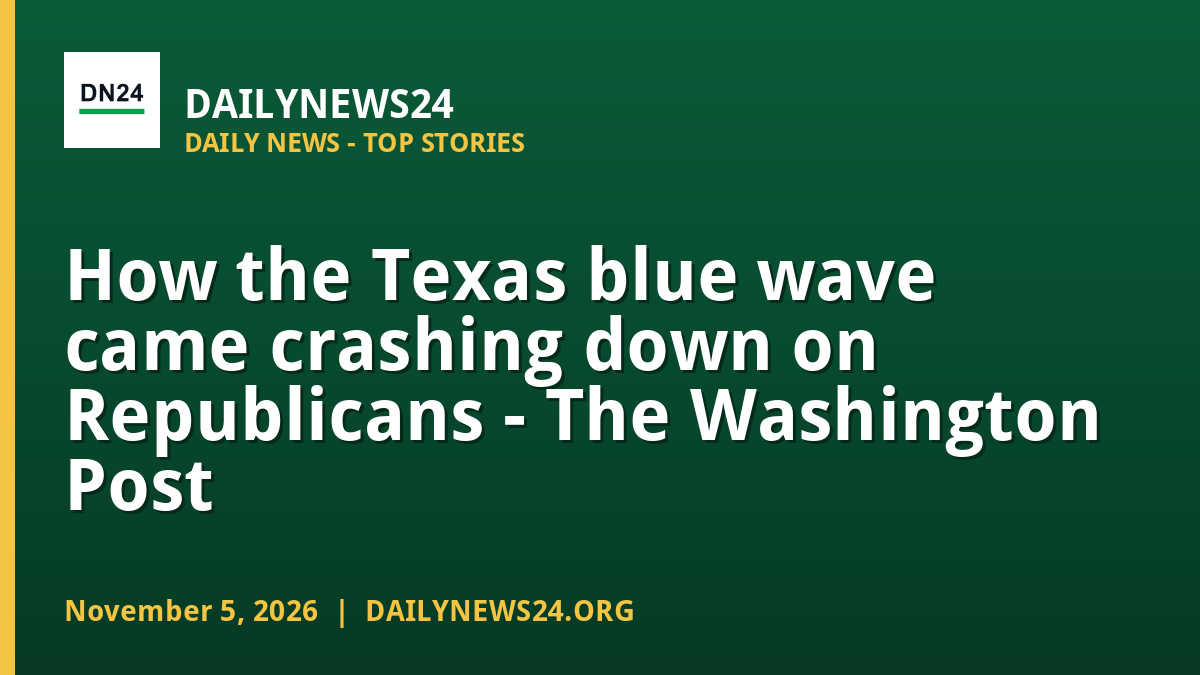
For nearly three decades, Texas stood as the unyielding fortress of the modern conservative movement. Political strategists in Washington and Austin treated the Lone Star State as a demographic anomaly: a massive, rapidly diversifying giant that nevertheless remained reliably governed by the Republican Party. Pundits had routinely dismissed forecasts of an impending political transformation, labeling the notion of a competitive Texas as an enduring mirage that consistently failed to materialize when ballots were counted.
That conventional wisdom collapsed in spectacular fashion during the most recent election cycle. A calculated, highly disciplined Democratic campaign, combined with deep-seated public discontent, produced a historic electoral upheaval. By dismantling long-standing conservative margins across suburbs, urban cores, and traditionally split counties, the Democratic coalition did not merely make inroads—it shattered the political aura of invincibility that defined Texas governance for an entire generation.
The Math Behind the Upset: Talarico’s Unprecedented Margin
At the center of this electoral earthquake was the statewide showdown between Democratic challenger James Talarico and entrenched Republican Attorney General Ken Paxton. While analysts initially anticipated a grinding, high-spending battle that would come down to the final precincts on Election Day, the actual arithmetic told an entirely different story before final polls even closed. Talarico’s campaign amassed an early voting margin so colossal that it fundamentally broke traditional forecasting models.
In a metric that sent shockwaves through conservative circles, Talarico secured more votes during the early voting window alone than Paxton accumulated across early voting and Election Day combined. By building an insurmountable lead before traditional voting day commenced, the Democratic apparatus neutralized the Republican strategy of relying on late-breaking, high-propensity conservative turnout. The sheer volume of early ballots underscored an enthusiasm gap that Republican strategists acknowledged they had severely underestimated.
The Machine and the Messaging: Anatomy of a Mobilization Triumph
Electoral shifts of this magnitude rarely happen by chance. Democratic operatives spent years laying the structural foundation for what culminated in an aggressive, high-tech political machine. Rather than relying on top-down messaging and broad television buys, the campaign invested heavily in hyper-localized digital microtargeting, multi-lingual field operations, and a relentless ground game that treated non-voters as viable targets rather than lost causes.
Equally critical was a deliberate pivot in rhetorical framing. Instead of nationalizing the contest around polarizing culture war debates, Democratic candidates maintained an ironclad focus on fundamental state-level grievances that crossed ideological divides:
- Public Education Investment: Championing state public schools and fiercely opposing private school voucher schemes that threatened funding for rural and suburban districts.
- Basic Infrastructure: Holding state leadership accountable for persistent concerns regarding power grid reliability and utility costs.
- Ethical Governance: Highlighting long-running legal troubles and institutional controversies surrounding incumbent leaders to appeal directly to moderate, independent suburbanites.
- Cost of Living Pressures: Directly addressing runaway property taxes and basic pocketbook issues confronting working-class families.
The Latino Vote: Disillusionment and Decisive Turnout
Reversing the Narrative of Conservative Gains
In recent election cycles, national media narratives frequently emphasized Republican inroads among Hispanic communities, particularly in the Rio Grande Valley and South Texas border regions. Pundits speculated that working-class cultural conservatism and economic concerns would permanently realign Latino voters into the Republican column. However, this historic cycle decisively scrambled that assumption, delivering an overwhelming surge in Latino voter participation that swung sharply toward the Democratic ticket.
A pervasive climate of frustration drove this surge to the ballot box. Escalating economic strain, persistent underinvestment in local healthcare and infrastructure, and increasingly aggressive state rhetoric around border security contributed to widespread voter fatigue. Communities that had historically suffered from low civic engagement turned out in numbers that completely overwhelmed local precinct expectations, proving that previous non-participation had been a symptom of neglect rather than conservative allegiance.
Policy Consequences: What the Realignment Means for Ordinary Texans
The collapse of unchallenged Republican hegemony brings immediate, tangible consequences for daily life across Texas. For decades, conservative lawmakers operated with a supermajority mentality, passing sweeping tax, social, and regulatory legislation with minimal input from opposition benches. That unchecked power dynamic has vanished overnight, fundamentally shifting the legislative balance of power in Austin.
For ordinary residents, this transformation alters key policy trajectories. Controversial efforts to divert state funds toward private school tuition have hit an impenetrable roadblock, ensuring that public education budgets will dominate future legislative debates. Furthermore, state regulatory agencies governing energy markets, environmental enforcement, and healthcare access now face genuine legislative oversight. Bipartisan compromise, long considered obsolete in Texas state politics, has suddenly become an unavoidable mathematical necessity for any major statute to pass.
The Republican Reckoning and Fractures in Austin
Inside the Texas Republican establishment, the aftermath of the defeat has triggered fierce recriminations and ideological finger-pointing. The party finds itself splintered between hardline, populist factions that insist the loss stemmed from insufficient ideological purity, and pragmatic conservatives who argue that polarizing state policies alienated essential suburban moderates and young professionals moving into the state.
The electoral catastrophe has also sparked urgent questions regarding campaign finance and strategy. For years, massive donations from deep-pocketed conservative megadonors dominated state primaries, driving the party toward hardline positions that ultimately proved toxic in a high-turnout general election. As party leaders conduct their post-mortems, the debate over how to rebuild their fractured coalition threatens to paralyze the state party leadership ahead of upcoming legislative sessions.
National Ramifications and the Electoral Map
The geopolitical impact of a competitive Texas extends far beyond state borders. In presidential politics, Texas has served as the foundational bedrock of the Republican Electoral College map. Without its 40 electoral votes safely locked inside the conservative column, national Republican candidates face an excruciatingly narrow path to the White House. National Democratic strategists, conversely, now see an opening to completely redefine the national political landscape.
This shift will inevitably alter national campaign finance and resource allocation. Republican national committees will be forced to spend tens of millions of dollars defending Texas media markets, siphoning critical funding away from traditional swing states like Pennsylvania, Wisconsin, and Georgia. Conversely, national donors will view Texas as a premier battleground worthy of sustained, multi-cycle financial infrastructure.
What to Watch Next
As the initial dust settles, political observers must monitor three pivotal dynamics to understand whether this election represents a temporary correction or a permanent realignment:
- The Upcoming Legislative Session: Watch how state leaders navigate budgetary negotiations, public school funding packages, and committee chair appointments in a newly balanced legislative chamber.
- Suburban Voting Patterns: Examine whether suburban counties surrounding Dallas, Houston, and Austin continue their rapid leftward trajectory or stabilize under fresh Republican messaging.
- Sustained Field Infrastructure: Monitor whether Democratic organizations retain their grassroots organizers on the ground or struggle to maintain operational momentum between major statewide election cycles.
Texas has undeniably entered unmapped territory. The unchangeable political reality that governed the state for thirty years has dissolved, leaving behind a hyper-competitive, unpredictable political landscape that neither party can ever afford to take for granted again.