A Crack in the Legal Shield
The legal landscape surrounding sexual consent in the United Kingdom is undergoing a significant period of scrutiny. For decades, the age of consent has served as a clear, unyielding statutory line, designed to protect minors from exploitation. However, recent high-profile accusations have exposed a nuanced gap in this protection, specifically regarding the power dynamics inherent in relationships between significantly older adults and younger teenagers who are legally adults for the purpose of consent but often lack the emotional maturity to navigate such interactions safely.
This debate has moved from the fringes of social media discourse to the front pages of major newspapers and into the chambers of Parliament. The catalyst for this renewed momentum is a series of serious allegations made against the comedian and radio host Russell Brand. These claims have not only reignited public anger regarding celebrity power but have also forced politicians to confront a specific legislative question: does the current legal framework do enough to protect young people in asymmetric power relationships?
The Allegations Against Russell Brand
The controversy centers on detailed allegations made by a woman who has chosen to waive her anonymity to bring her case to light. She has accused Brand of raping her when she was sixteen years old. At the time of the alleged incident, Brand was thirty years old. This fifteen-year age gap is a central element of the narrative, highlighting a stark disparity in life experience, social standing, and financial influence.
In her account, the accuser describes a dynamic where the power imbalance was overwhelming. She has specifically referenced moments where Brand allegedly used language and behavior that emphasized her youth and vulnerability, referring to her in ways that underscore the chasm between their positions in society. The severity of the allegations, including claims of physical force and specific sexual acts, has drawn widespread attention. By speaking publicly, the accuser has aimed to bypass the typical anonymity granted to victims in criminal proceedings, hoping to use her platform to advocate for systemic change rather than just individual justice.
These allegations are part of a broader pattern of accusations levelled against Brand over the years. While some previous claims were retracted or challenged in civil court, the recent testimony adds a layer of factual specificity that has resonated with the public. The timing is critical, occurring during a period when the #MeToo movement and its successor, #WhyIDidntReport, have fundamentally shifted the cultural lens through which sexual misconduct is viewed.
Political Response and Legislative Debate
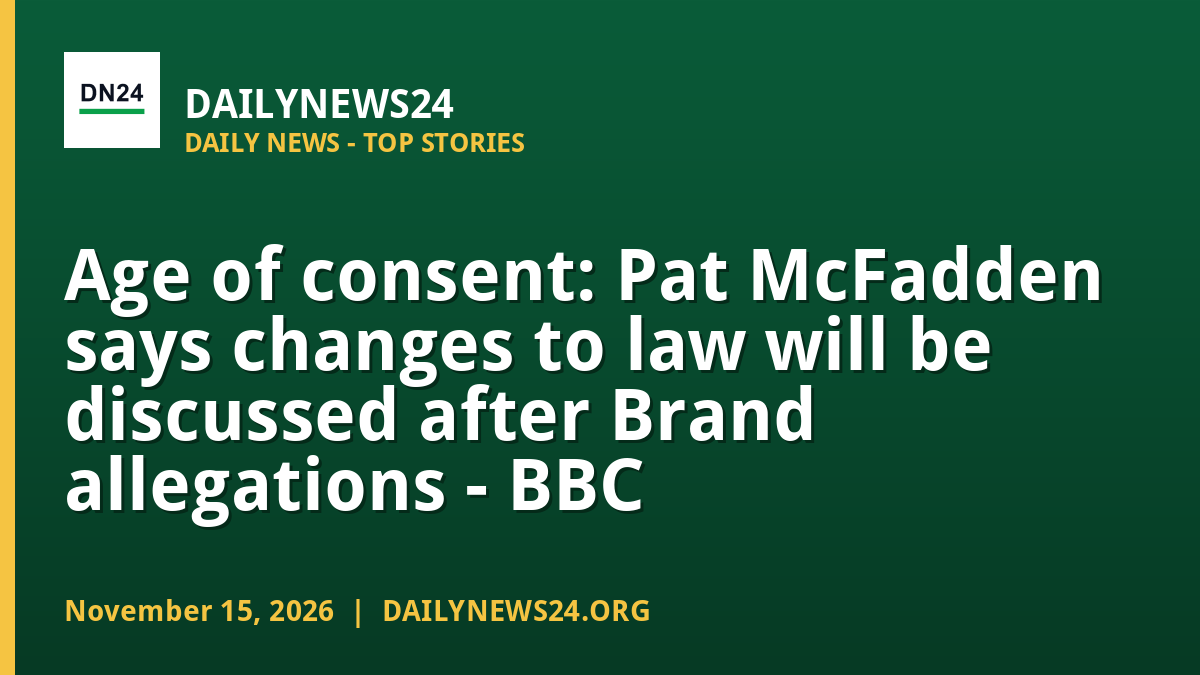
Amidst the growing public outcry, Pat McFadden, the Shadow Secretary of State for Health and Social Care, has indicated that the issue of the age of consent will be subject to serious discussion within his political circle. His comments suggest that the Labour Party, and potentially the broader parliamentary landscape, is open to examining whether the current legal definitions adequately address situations where a minor is legally consenting but is in a relationship with a significantly older, powerful adult.
This is not a call for an immediate vote, but rather a signal that the topic is being elevated from a cultural debate to a policy discussion. McFadden’s remarks imply that there is a recognition that the current law, while protecting those under sixteen, may leave those aged sixteen and seventeen in a precarious position when facing adults with disproportionate power. The discussion is likely to focus on whether 'grooming' or 'exploitation' laws need to be extended or clarified to cover these specific scenarios more effectively.
The Legal Nuance of Consent
To understand why this is contentious, it is necessary to look at the current legal framework. In England and Wales, the age of consent is sixteen. This means that any sexual activity between two people, both aged sixteen or over, is technically legal, provided that consent is freely given. The law does not generally account for age gaps once both parties have crossed this threshold, unlike some other countries that have specific statutes prohibiting relationships between adults and teenagers who are close to the age of consent.
The gap in protection is most evident in cases involving authority figures or celebrities. A sixteen-year-old may legally have the capacity to consent, but critics argue that they are often unable to fully comprehend the long-term consequences of a sexual relationship with a thirty-year-old media personality. The concept of 'unequal power' is central to this argument. If a young person is being coached, pressured, or influenced by someone with significant resources and social capital, the voluntariness of their consent is debatable.
- The current law protects those under 16 strictly.
- Individuals aged 16 and 17 are treated as having full legal capacity regarding consent.
- Power imbalance is not currently a standalone criminal defense or offense in most UK statutes.
- Public sentiment suggests a need for 'protections for the vulnerable' beyond the binary age threshold.
Competing Perspectives on Safety and Liberty
Supporters of legal reform argue that the law must evolve to reflect psychological reality. They contend that teenagers, particularly those in their early six, are still developing cognitively and emotionally. Allowing a powerful adult to exploit a young person’s naivety, simply because that person has turned sixteen, creates a dangerous loophole. From this perspective, the law should prioritize the protection of the vulnerable over the strict interpretation of age-based capacity.
On the other hand, opponents of changing the age of consent or adding complex power-dynamic provisions warn against the potential for legal overreach. They argue that defining 'power imbalance' in a criminal statute is inherently subjective and could lead to inconsistent enforcement. There is also a concern that lowering the threshold for prosecution or altering the definition of consent could infringe upon the personal freedoms of adults. Critics suggest that existing laws against grooming, sexual exploitation, and assault are sufficient to address malicious behavior, and that the issue lies more in enforcement and societal awareness rather than legislative text.
What This Means for Ordinary Citizens
For the average reader, this debate touches on fundamental questions about safety, autonomy, and the role of the state in private relationships. If the law is changed to better protect sixteen and seventeen-year-olds in relationships with significantly older adults, it could send a strong message that the justice system takes the vulnerability of young people seriously. It could also provide a clearer pathway for victims who feel that the current legal system fails them because of their age, even if that age is technically above the consent line.
However, such changes would also require careful calibration to avoid unintended consequences. It would likely involve training for law enforcement and judiciary to interpret these new or clarified provisions. For parents and guardians, it offers a clearer framework for understanding the risks their teenagers face in the digital and social spheres, where exposure to older adults is increasingly common. The goal, for proponents, is to create a legal environment where consent is not just a legal checkbox, but a genuine, informed, and safe process.
Outlook and Next Steps
While no legislation has been drafted or introduced as a direct result of these specific allegations, the political atmosphere is shifting. The willingness of high-ranking shadow ministers to discuss the topic publicly suggests that this is no longer a taboo subject in parliamentary circles. In the coming months, watch for inquiries from select committees on justice or health, policy papers from think tanks focused on child protection, and further statements from opposition parties as they prepare for potential general elections.
The outcome of this debate will likely depend on how the public narrative evolves. If the focus remains on the specific case of Russell Brand, the discussion may remain confined to celebrity misconduct. However, if the conversation broadens to include systemic protections for all young people in vulnerable positions, there is a tangible possibility of legislative reform. For now, the age of consent remains at sixteen, but the understanding of what that number truly signifies is being challenged by both legal scholars and the victims who have stepped forward to tell their stories.