A Strategic Pivot in Washington
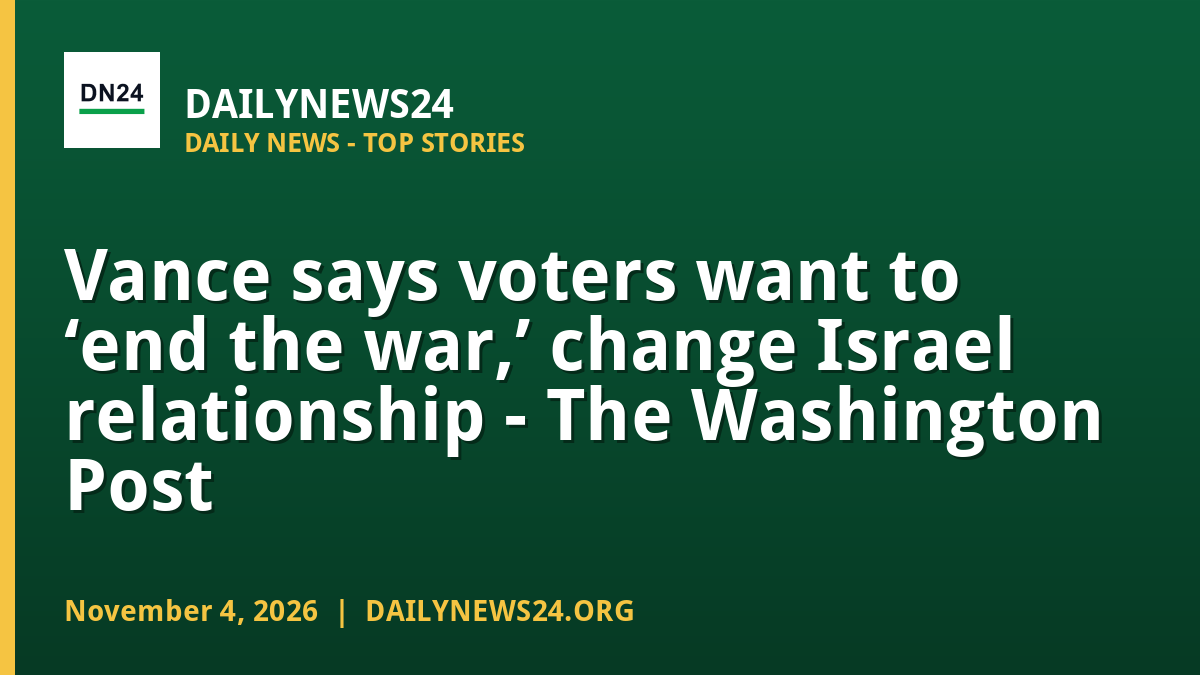
JD Vance, the Vice President of the United States, has delivered a significant rhetorical shift that signals a potential realignment within the Republican Party. In a series of recent comments, Vance suggested that a substantial segment of the American electorate is no longer prioritizing foreign policy interventions, specifically those involving Israel and Iran. Instead, he argued that voters are demanding an end to ongoing conflicts and a fundamental restructuring of the U.S. relationship with Jerusalem. This stance marks a notable departure from the traditional hawkish consensus that has long dominated the party's foreign policy platform, forcing both allies and opponents to reassess the political landscape heading into the next election cycle.
The timing of these remarks cannot be ignored. Coming shortly after the 2026 midterm elections, Vance’s analysis offers a stark interpretation of why Republican candidates suffered historic losses across the country. By attributing these defeats to voter fatigue over the Iran war, he effectively places the burden of the electoral outcome on the administration’s foreign policy decisions rather than domestic economic or social issues. This narrative strategy is a calculated move to pre-empt criticism from the party’s base while simultaneously appealing to a broader coalition of disaffected voters who feel alienated by endless military engagements.
Contextualizing the Midterm Defeat
The 2026 midterms resulted in a historic rebuke of the Republican Party, with Democrats regaining significant ground in both chambers of Congress. For months, political analysts and party insiders have debated the primary drivers behind this shift. While economic concerns and inflation have always been top priorities for voters, the persistence of armed conflict in the Middle East has emerged as a critical factor in the collective mood. Vance’s assertion that the war drove this dissatisfaction suggests that the cost of maintaining military operations, both in terms of financial resources and political capital, has finally outpaced the perceived benefits of strategic partnership.
- Erosion of Support: Data indicates a measurable drop in approval ratings for the administration’s handling of the Middle East over the past six months.
- Demographic Shift: Younger male voters, traditionally a strong Republican demographic, have shown increased opposition to new military commitments in the region.
- Media Narrative: Coverage of the conflict has increasingly focused on its protracted nature, fueling public sentiment that the original objectives have not been achieved.
This convergence of factors created a volatile environment for Republican candidates. Many found themselves defending a foreign policy they personally supported but which voters clearly rejected. Vance’s intervention serves as a post-mortem, identifying the specific policy failure that contributed to the broader electoral setback. By naming the Iran war as the culprit, he provides a clear, albeit controversial, explanation that resonates with those who felt disconnected from the campaign messages during the primaries.
The Fracture with Donald Trump
Perhaps the most significant implication of Vance’s remarks is the implicit break with President Donald Trump’s long-standing advocacy for a robust, unconditional support for Israel. Trump has historically positioned himself as the strongest ally in American history for the Jewish state, often framing his relationship with Prime Minister Benjamin Netanyahu as a cornerstone of his leadership. Vance’s suggestion that voters want to “change the relationship” with Israel implies a necessary softening of this stance. This creates a tension at the highest levels of the administration, where two of the most prominent figures are now articulating divergent views on one of the most sensitive issues in U.S. foreign policy.
This divergence is not merely academic; it has immediate implications for diplomatic negotiations and domestic lobbying. Pro-Israel advocacy groups, which wield significant influence in Republican primary contests, are unlikely to welcome a shift toward distancing the U.S. from Israel. Conversely, the growing faction of the party known as the “America First” wing, which prioritizes non-intervention and fiscal conservatism, may see Vance’s words as a validation of their long-held beliefs. The party now faces the challenge of reconciling these two powerful currents. If Vance’s interpretation of the midterm results is accepted as the prevailing truth, the Republican platform may undergo a significant revision, potentially alienating traditional base voters while courting moderates.
Voter Sentiment and the Cost of Conflict
To understand why Vance is making this argument, one must look at the changing priorities of the American voter. For decades, foreign policy was often a secondary concern for the average citizen, who were more focused on jobs, healthcare, and education. However, the intensity and visibility of the Iran conflict have brought foreign policy to the forefront of the national conversation. The sustained military operations, the financial costs, and the geopolitical instability have created a sense of weariness that transcends partisan lines. Many voters, regardless of their political affiliation, are questioning whether the U.S. is achieving its strategic goals or merely getting bogged down in regional proxies.
Vance’s appeal to this sentiment is a masterclass in political timing. By framing the issue not as a rejection of Israel, but as a desire for “change” and an “end to the war,” he navigates a delicate tightrope. He acknowledges the depth of public frustration without explicitly condemning allies or abandoning core security interests. This nuance is crucial for maintaining his credibility within the party while addressing the concerns of the electorate. It suggests a new political calculus where the cost of foreign intervention is weighed more heavily against domestic stability and economic growth. For the reader, this means a potential shift in how U.S. foreign aid and military support are structured in the coming years.
Implications for Future Diplomacy
If the Republican Party begins to internalize Vance’s assessment, the diplomatic landscape in the Middle East will shift significantly. A U.S. administration that feels pressured to de-escalate or restructure its relationship with Israel may adopt a more transactional approach to security agreements. This could involve conditional support, increased demands for reciprocal security measures from Israeli leadership, or a greater push for diplomatic solutions that limit military action. Such a shift would be a major departure from the recent past and could embolden adversaries who have calculated that U.S. commitment is weakening.
Furthermore, this change would likely intensify debates within the National Security Council and the State Department. Advisors who advocate for unconditional support will clash with those who argue for a realignment that satisfies domestic political realities. The outcome of this internal struggle will determine the trajectory of U.S.-Israel relations for the remainder of the Trump administration and beyond. It is a high-stakes balancing act where missteps in either direction could have severe consequences for regional stability and American credibility on the world stage.
What to Watch Next
As the political dust settles from the midterms, several key developments will test the viability of Vance’s narrative. First, observe the reaction from the President’s immediate circle. If Trump publicly endorses Vance’s view or remains silent, it signals a genuine shift in party orthodoxy. If there is pushback, the party may remain fractured, hindering its ability to present a united front in the next presidential cycle. Second, watch for legislative moves in Congress. If Republican members of the new majority begin introducing bills that limit military funding for the region or alter the terms of aid to Israel, it will confirm that the rhetoric is translating into policy.
Finally, monitor the response from international allies and adversaries. Israel’s leadership will be closely watching Washington to determine if this is a temporary political posture or a permanent strategic pivot. Similarly, Iran and other regional players will assess the U.S. resolve based on these signals. The next few months will be critical in determining whether Vance’s warning represents a new beginning for American foreign policy or a momentary pause in a long-standing commitment. The stakes are high, and the consequences of getting it wrong could extend far beyond the next election cycle, impacting global security and the U.S. role in the Middle East for decades to come.