A Strategic Pivot on the Wartime Narrative
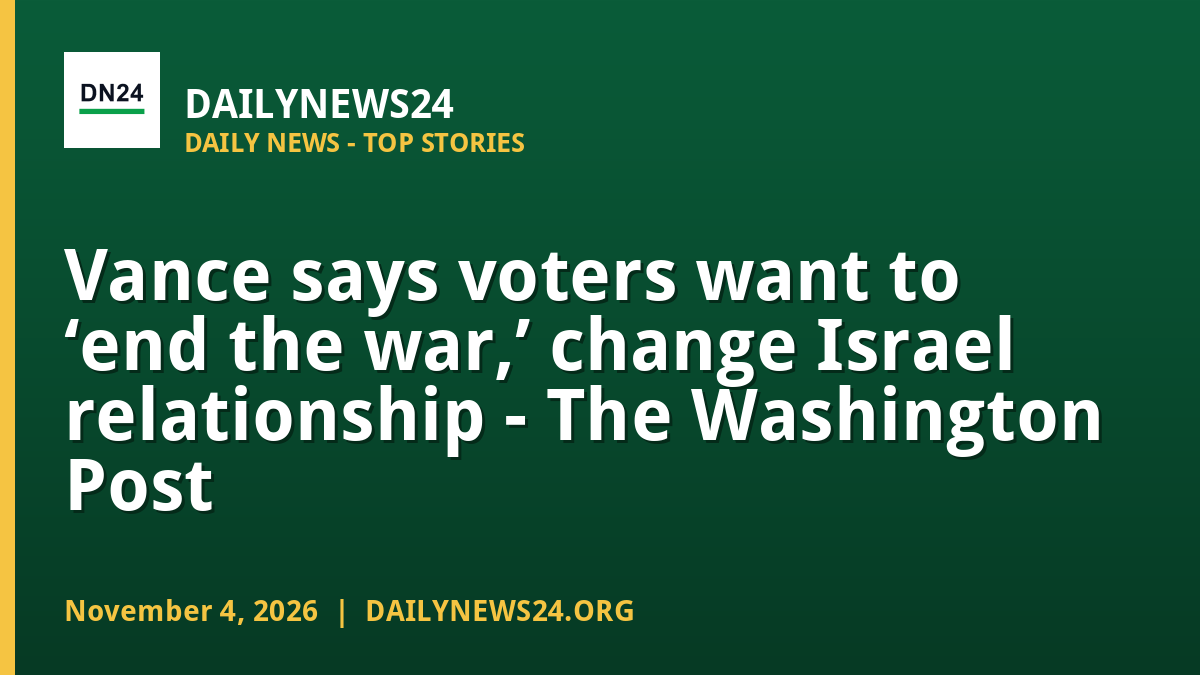
In a significant departure from the administration's previous unified front, Vice President JD Vance has publicly linked the Republican Party's recent electoral setbacks to widespread voter dissatisfaction with the ongoing conflict in Iran. This assessment marks a notable shift in the political narrative, moving away from the 'rally around the flag' rhetoric that typically dominates wartime discourse. By identifying the war as the primary driver of the GOP's poor performance, Vance is effectively challenging the prevailing wisdom that external threats generally consolidate domestic political support for the executive branch. This move suggests an internal acknowledgment that the war's toll on the American public has outweighed any potential patriotic unity it might have generated.
The implications of this shift are profound, not only for the immediate aftermath of the midterms but also for the broader trajectory of American foreign policy. If the leadership is now willing to concede that the war is a political liability, it opens the door for a reevaluation of military commitments and diplomatic strategies. This is not merely a statement of regret but a tactical assessment of voter sentiment that could reshape the administration's approach to the Middle East. For policy analysts, this represents a critical data point in understanding how modern Americans perceive the intersection of national security and domestic political viability.
Contextualizing the Electoral Rebuke
The Weight of Midterm Reality
History is replete with examples of incumbent parties suffering significant losses in midterm elections, a phenomenon often attributed to the natural ebb and flow of political cycles. However, the scale and nature of the recent Republican defeat have prompted deeper scrutiny. Vance’s comments suggest that the loss was not merely a standard correction but a direct response to specific policy failures, particularly regarding the Iran conflict. This perspective contrasts sharply with earlier internal party assessments that may have pointed to economic concerns or cultural issues as the primary causes. By isolating the war as the 'real reason,' Vance is reframing the narrative to focus on foreign policy over domestic economic grievances.
This reattribution of cause and effect is crucial for understanding the current political mood. It indicates that a segment of the Republican base, traditionally supportive of strong military action, may be fatigued by the conflict's duration and cost. The data from recent polls and exit interviews, while not explicitly detailed in Vance's immediate statements, align with broader trends showing increased anxiety about international entanglements. This shift hints at a more nuanced voter base that is less monolithic in its support for aggressive foreign interventions, challenging the administration to adapt its messaging to reflect these evolving sentiments.
The Fracture in the Party Unity
Perhaps the most contentious aspect of Vance’s remarks is the implicit criticism directed at the President and the top-tier decision-makers within the administration. By stating that voters want to 'end the war,' Vance is effectively placing responsibility on the leadership for a policy that has become unpopular. This has been interpreted by some observers as a subtle attempt to distance himself from the president's foreign policy decisions, a strategic move often seen in high-stakes political environments. Such a tactic can be viewed as a bid to preserve his own political capital for future ambitions, particularly with his eye on the 2028 presidential election.
The reaction to this perceived 'tossing under the bus' has been mixed. Loyalists within the party have largely stayed silent, maintaining public unity, but internal communications reportedly show growing tension. The idea that a Vice President would publicly contradict the president's core policy stance is unprecedented in recent history. This fracture could have lasting effects on party cohesion, potentially creating a wedge between the more interventionist wing and the emerging populist faction that prioritizes domestic stability over global hegemony. The balance of power within the Republican establishment is now shifting, with figures who are willing to challenge the status quo gaining temporary leverage.
Reassessing the US-Israel Relationship
Shifting Diplomatic Priorities
Vance’s comments also touch upon the broader implications for the United States' relationship with Israel. Historically, this alliance has been a cornerstone of American foreign policy, supported by bipartisan consensus. However, the suggestion that voters want to 'change' this relationship implies a willingness to reconsider the scope and nature of American support. This does not necessarily mean a severing of ties, but rather a potential recalibration of military aid, diplomatic backing, and public rhetoric. The goal, as implied by the demand to 'end the war,' is to reduce American involvement in a conflict that has become increasingly unpopular at home.
Such a shift would have ripple effects across the region and globally. It could embolden adversarial actors who perceive a weakening of the US commitment to its allies. Conversely, it might also signal to the Israeli government that it needs to seek new diplomatic solutions that do not rely entirely on American military dominance. The complexity of these dynamics requires careful navigation, as any perceived weakening of the alliance could be exploited by opponents of the current administration. The challenge for US diplomats will be to manage these expectations while maintaining credibility on the international stage.
Implications for Ordinary Americans
For the average American, these political maneuvers translate into tangible concerns about economic stability and personal safety. The cost of prolonged military engagement, both in terms of financial resources and human life, has weighed heavily on public opinion. The demand to 'end the war' is, in many cases, a demand for a return to normalcy and a focus on domestic issues such as healthcare, education, and infrastructure. Voters are increasingly aware that resources allocated to foreign conflicts are diverted from critical domestic needs, creating a direct link between foreign policy and household budgets.
- Economic Impact: Reduction in military spending could free up resources for domestic programs, potentially lowering taxes or increasing social services.
- Security Concerns: A shift in foreign policy may alter the perceived security environment, requiring Americans to adapt to new diplomatic realities.
- Political Participation: This issue is likely to drive higher voter turnout in future elections as citizens seek to reward or punish parties based on their foreign policy stances.
Moreover, the polarization surrounding this issue means that the outcome of these political battles will directly influence the tone of public discourse. The ability of the media to frame these issues will play a crucial role in shaping voter perceptions. Citizens are now more informed and critical, demanding accountability from their elected officials regarding the effectiveness and necessity of military actions. This heightened awareness ensures that the debate over the Iran war will remain a central topic in American politics for the foreseeable future.
Outlook: What to Watch Next
As the administration begins to formulate its response to these electoral signals, several key developments will determine the trajectory of US foreign policy. First, any official statements from the White House regarding a potential de-escalation or diplomatic breakthrough will be closely monitored. The administration will likely seek to balance the need to appease domestic voters with the strategic imperatives of maintaining global influence. This balancing act will be difficult, especially in a polarized political environment where any concession can be framed as weakness by opponents.
Second, the internal dynamics of the Republican Party will be crucial. The friction between Vance and the President's office could define the leadership structure for the next cycle. If this split widens, it could lead to a fragmented party that is less effective in governing and more prone to internal conflict. Conversely, a unified response could strengthen the party's hand in negotiations with the opposition. The coming months will provide critical insights into whether the Republican Party is capable of adapting its foreign policy to meet the changing demands of its electorate, or if it will remain entrenched in a strategy that has already proven electorally costly. The stage is set for a major realignment in American foreign policy, driven by the simple but powerful demand from the voting public: bring them home.